NF525 till in a card shop: what 2026 requires
Secure POS software (NF525) and card shops in France: who must comply, how to prove it, the publisher's attestation reinstated in 2026, and the risks.
By Paul Hilmarcher, founder of Echo TCG, working hand in hand with card shops.
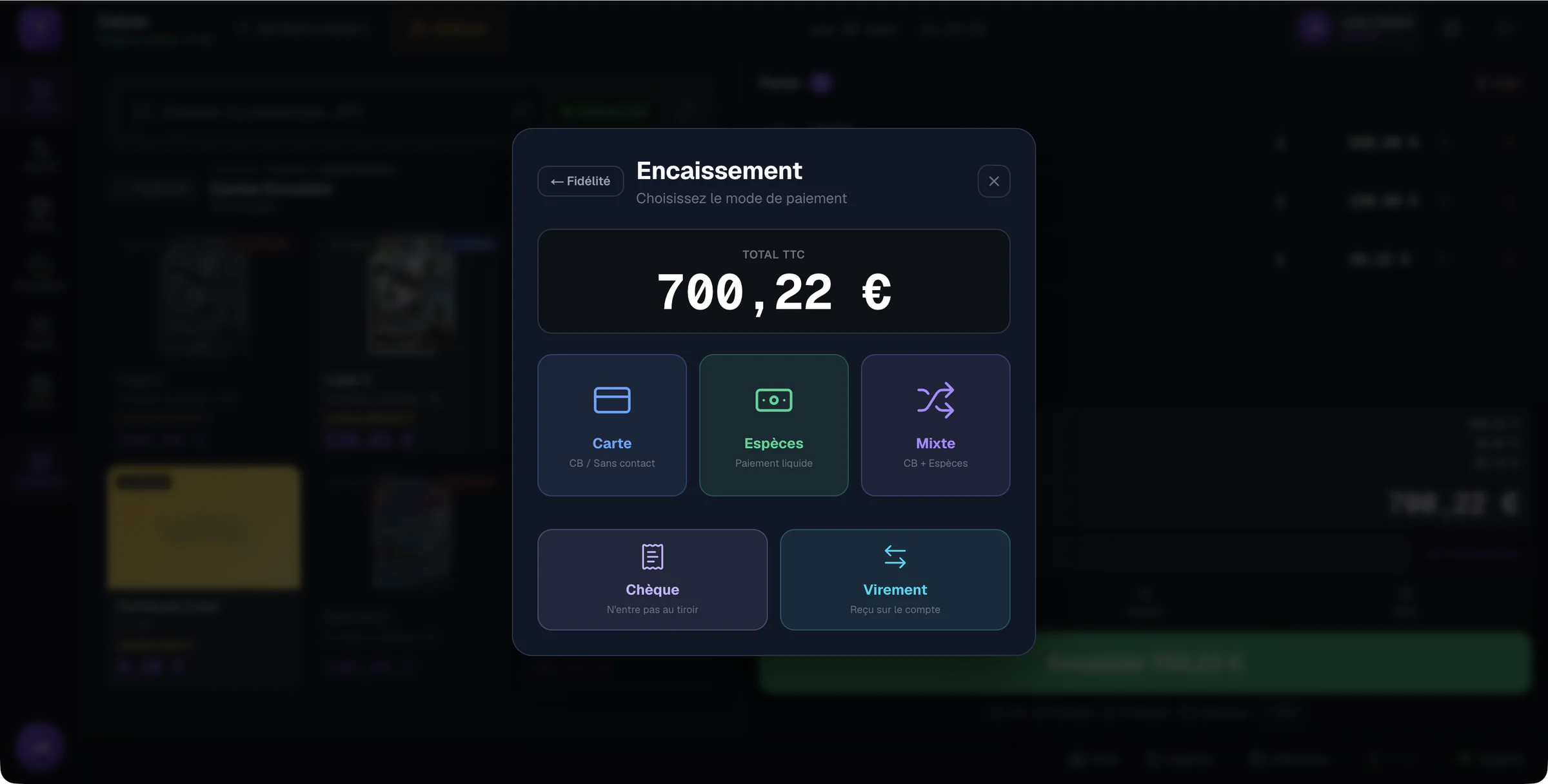
Under France's anti-VAT-fraud law, a VAT-registered shop recording payments from consumers through POS software must use secure software: inalterability, security, retention and archiving of data (the four “ISCA” conditions), proven by a certificate or the publisher's attestation (art. 286, I-3° bis of the French tax code). Card shops are concerned like any retailer. Shops under the VAT basic exemption are exempt, as are those selling only to businesses.
The four conditions to meet
- Inalterability: a recorded sale can't be deleted or modified (a correction goes through a reverse operation).
- Security: authenticated access, traceability of operations.
- Retention: daily, monthly and annual closures with a perpetual running total.
- Archiving: a frozen, re-readable archive of sales data.
The publisher's attestation: what changed in 2026
France's 2026 finance law (law no. 2026-103 of 19 February 2026, art. 125) reinstated, from 21 February 2026, the publisher's ability to issue an individual attestation of compliance, following the model set by the tax authority, as an alternative to certification by an accredited body (AFNOR/LNE). In practice, the software publisher attests that the product meets the four conditions, for a given version: for version 1.0.0 of Echo TCG; a new major version gives rise to a new attestation.
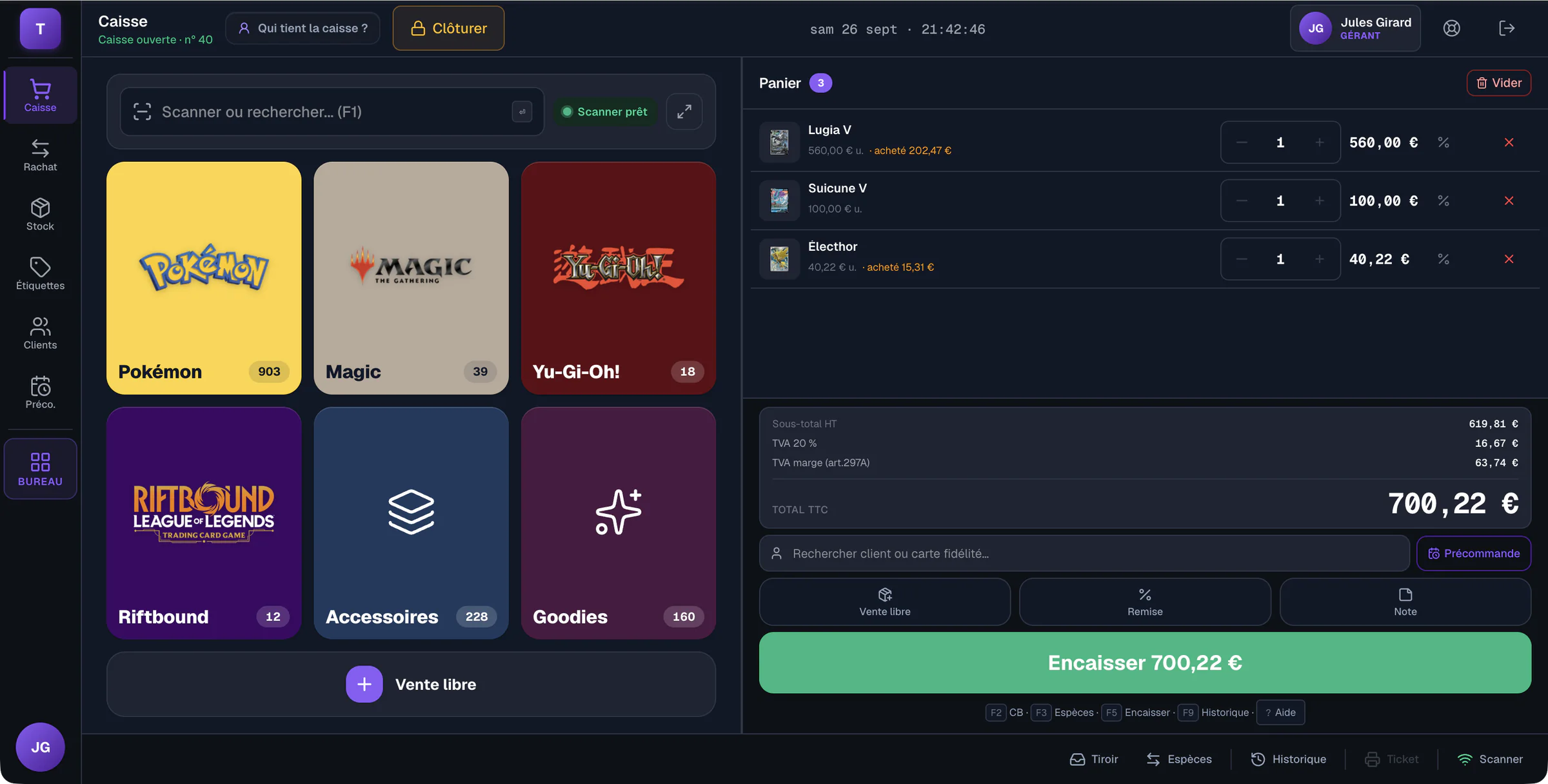
Echo TCG, the software published by this site, takes this route: its publisher signed an individual attestation on 2 October 2026, a secure till within the meaning of art. 286, I-3° bis of the French tax code. Echo TCG's features, prices and limits are set out on a single page.
Risks of non-compliance
It's the retailer who must be able to present, on inspection, the certificate or attestation of the software they use. Failing that, the fine is €7,500 per piece of software, with 60 days to comply (art. 1770 duodecies of the French tax code). Before choosing, ask the publisher for the certificate or individual attestation it will give your shop.
Since June 2026 (law no. 2026-534 of 25 June 2026), tax officers can note on site the references of the software and the terminals and ask for the attestation; a device that is not presented costs €7,500 each (art. 1770 quaterdecies of the French tax code).
Who is concerned, and who is not
The obligation covers VAT-registered businesses that record payments from private customers with till software or a till system; it has applied since 1 January 2018. The French tax authority notably excludes businesses under the VAT basic exemption (franchise en base), those making only exempt supplies, and those selling only to other businesses, since every sale is then invoiced. A shop that leaves the exemption comes within the scope of the obligation.
What article 286, I-3° bis of the French tax code says
The text requires VAT-registered businesses that record their customers' payments with accounting or management software, or a till system, to use software or a system that meets conditions of unalterability, security, retention and archiving of data, so that the tax authorities can audit it. Proof is a certificate issued by an accredited body, or an individual attestation by the publisher drawn up on the model set by the administration. The text speaks of conditions and proof, not of a brand: “NF525” is the most quoted certification standard, and the individual attestation is the other accepted proof.
Five questions to ask the publisher before choosing
- What proof do you give my shop, a certificate or an individual attestation, and for which version of the software?
- Does that proof cover all the tills and all the modules I will use?
- What happens to the proof at each software update?
- How do I obtain the daily, monthly and annual closings, and the data archive?
- Can a recorded sale be deleted, and how is an input error corrected?
The answers are worth more than a claim on a sales page. They can be compared between publishers, and the article on the criteria for choosing till software sets them alongside the other points to examine.
Keeping your evidence
In an inspection, presenting the certificate or the attestation is the trader's responsibility. Keep the document supplied by the publisher, with the software version it concerns, somewhere you can find quickly. Keep the closings and the archive the software produces as well. Inspectors can note the software and terminal references on site: better to know them in advance.
What a secure till does not settle
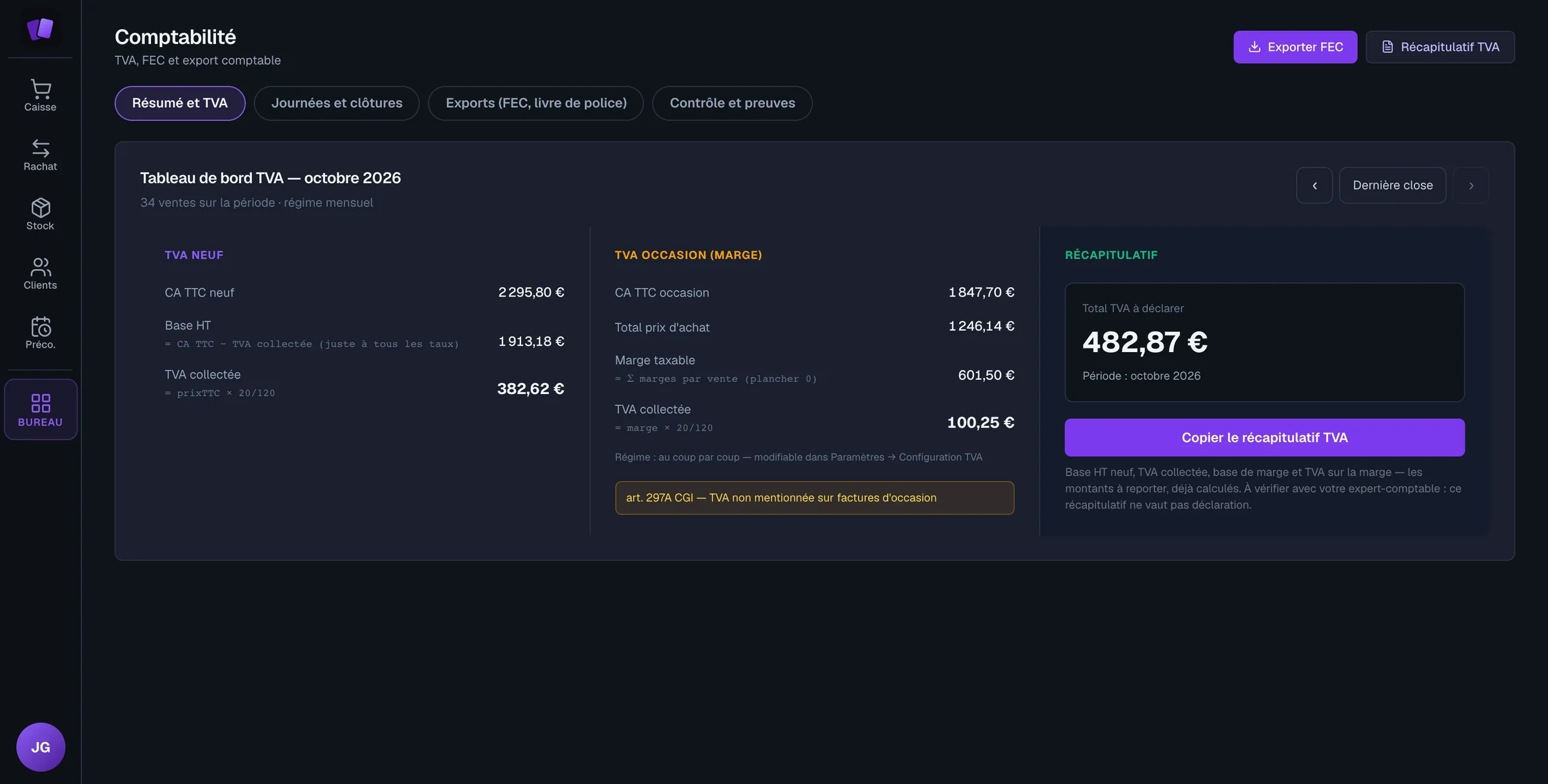
Secure software says nothing about the VAT applied. Margin VAT and the police register are other obligations, with their own texts. And if the shop is under the VAT exemption (franchise en base), the obligation does not apply while it stays there: the tax diagnostic helps spot when it might leave it, as a general orientation.
Official sources
- Article 286 of the French Tax Code (Légifrance, in French): the obligation, its four conditions and the two accepted proofs
- Article 1770 duodecies of the French Tax Code (Légifrance, in French): the €7,500 fine and the 60-day deadline
- BOFiP, BOI-TVA-DECLA-30-10-30 (in French): the tax authority's guidance
- BOFiP news, 2026 (in French): the publisher's attestation reinstated (law no. 2026-103, art. 125)
- impots.gouv.fr (in French): who is concerned by the obligation
This article is informational and does not replace professional advice.
Frequently asked questions
- Does a card shop need secure till software?
- Yes, if it is VAT-registered and takes payments from consumers through POS software: it must use secure software, proven by a certificate (NF525, for example) or the publisher's attestation. A shop under the VAT basic exemption is not subject to it.
- Is AFNOR or LNE certification still required in 2026?
- No, not necessarily. France's 2026 finance law reinstated the publisher's ability to issue an individual attestation of compliance, an alternative to certification by an accredited body.
- What are the risks of using non-compliant POS software?
- On inspection, the retailer must present the software's certificate or attestation. Failing that, the fine is €7,500 per piece of software, with 60 days to comply (art. 1770 duodecies of the French tax code).
- What is the difference between NF525 and the publisher's attestation?
- Both prove that the software meets the four conditions of article 286, I-3° bis of the French tax code. The certificate is issued by an accredited body; the attestation is drawn up by the publisher itself, on the administration's model, for a given version of the software.
- Must a shop under the VAT exemption change its till if it goes over the threshold?
- As soon as it becomes subject to VAT, it falls within the obligation. It is better to ask the publisher for the proof before the threshold is crossed than to change tools in a hurry.
Echo TCG: the POS and management software for card shops.
From €49 a month, with no commission on your sales. See pricing