Running official tournaments in your card shop
Publisher programme, preparing the event, entry fee, prizes and insurance: what a shop must settle before its first tournament.
5 minCheckout, buy-back, inventory, customers, team and accounting: every module described here exists in the software, with the plan that unlocks it.







The till is in every plan and is never restricted: a late subscription never blocks a sale.
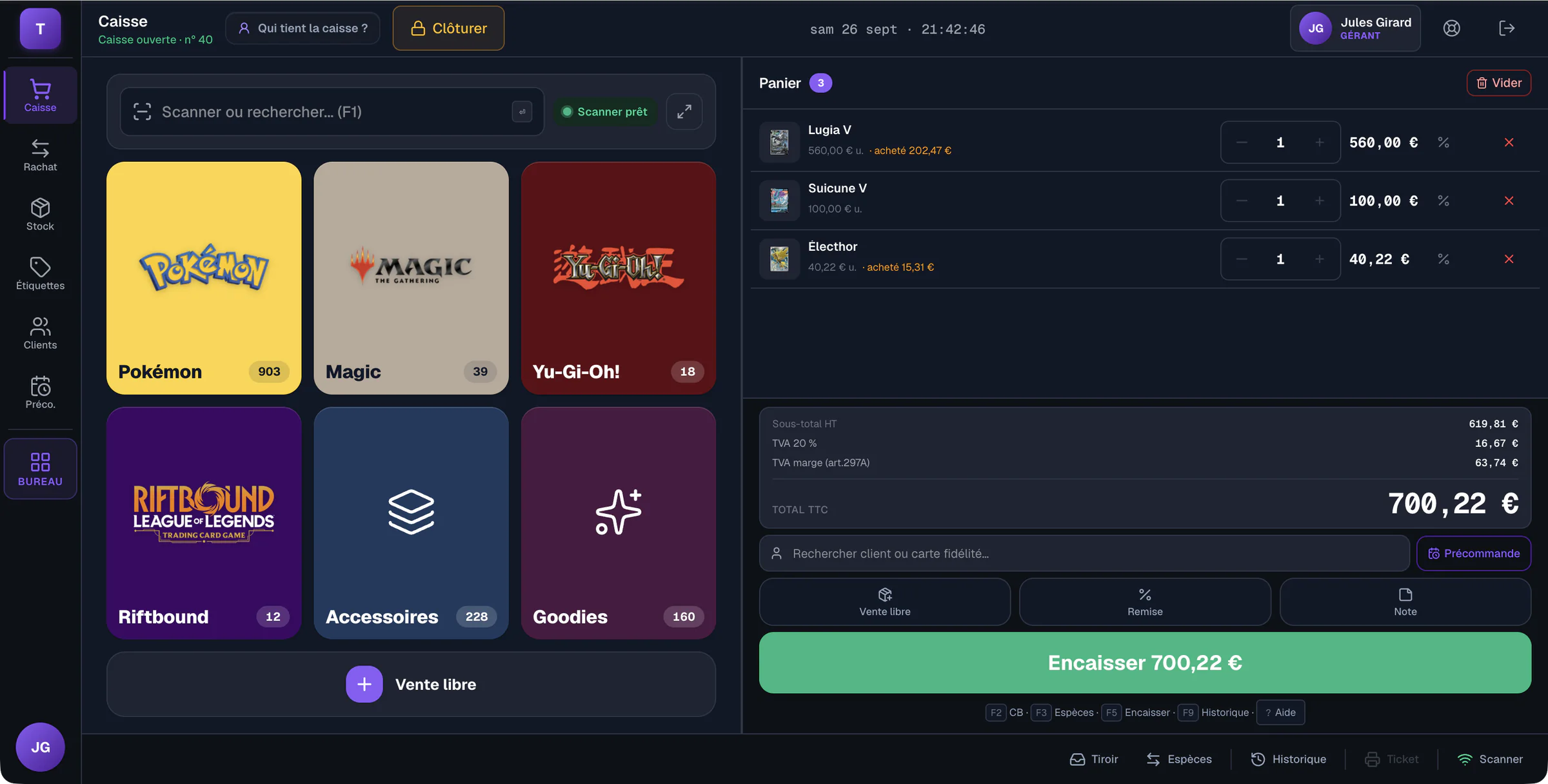
Tiles. One game, one tile, with its product count. The scanner and search stay right above.
One game, one tile: a booster is two taps away. The manager arranges the grid and the menu in settings.
Card on your existing terminal, cash with change due, split payment, cheque or bank transfer.
Above the shop's threshold, a manager approves. The discount shows on the receipt and on the closing.
A sale is never deleted: it is reversed, with discounts refunded pro rata.
Thermal printer over USB or Wi-Fi, cash drawer kick, or receipt emailed to the customer.
Each till has its own drawer, float and closing. Tills included by plan, more as an option.
Numbered and sealed on the till, then sent when the connection returns. Everything else waits for the network.
Reloading the page no longer loses the sale in progress.
From a collector's binder to a box of bulk, with the seller's identity and the police register kept as you go.
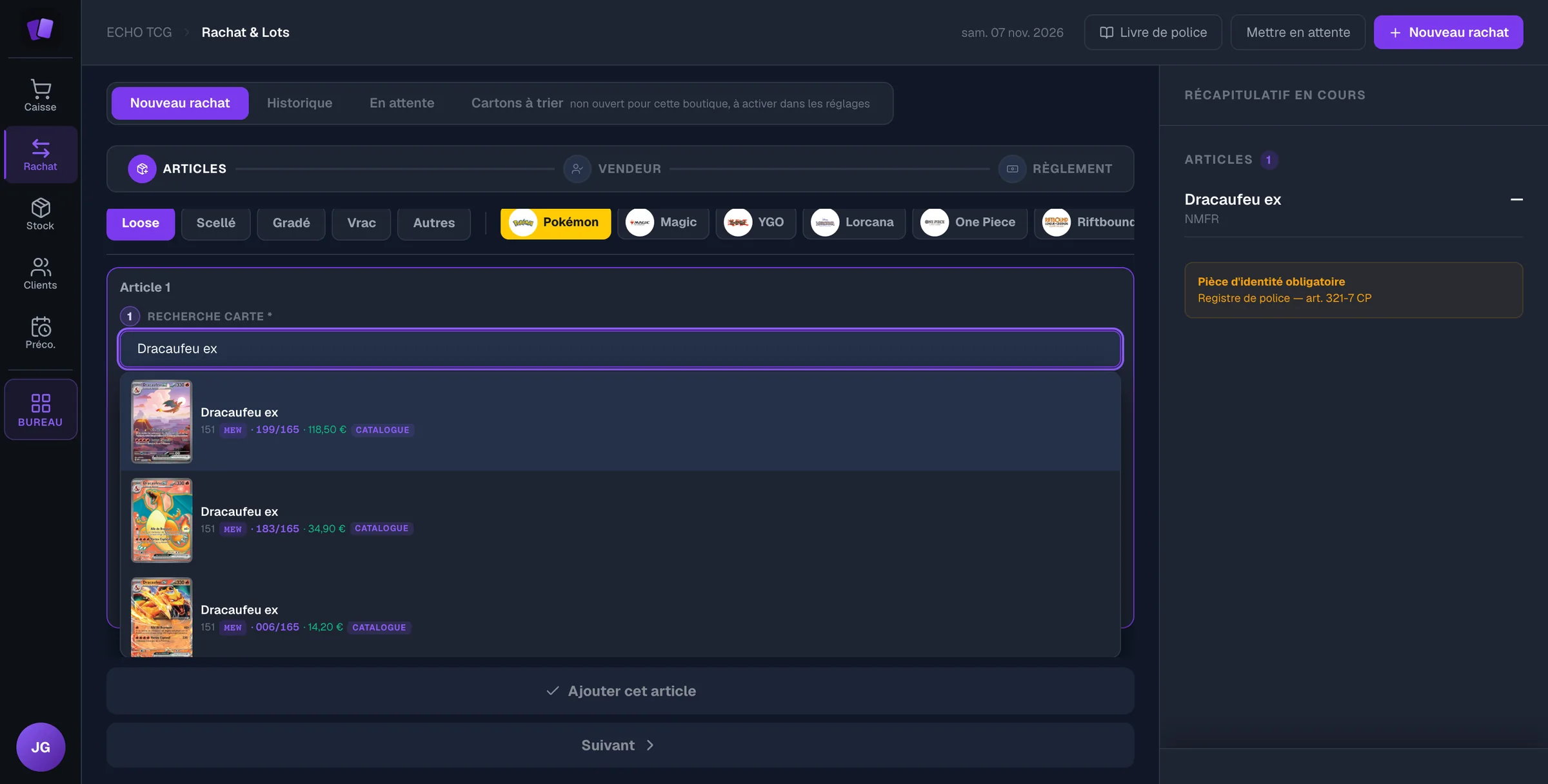
Three steps. Items, seller, payment: a buyback runs in order, with nothing forgotten.
Type the number printed on the card (125/094, OP17-022, LEDE-EN001…) or its name: each version comes up with its set and, where one exists, its market price.
The shop's rate suggests a price from the condition and finish, the seller negotiates. Direct link to the card's Cardmarket page and to completed eBay sales.
Commons, holos, EX and others: one price per pile, and two purchase prices are never merged in stock.
The register of second-hand purchases required in France fills itself at each buy-back, with the seller's identity.
Cash within the €1,000 legal limit, bank transfer, cheque or store credit. Receipt as PDF, printed or emailed.
One part in cash, the rest by bank transfer, cheque or store credit: only the cash part leaves the drawer.
A valuation can be set aside and picked up later, with nothing entered in stock until it is concluded.
One price for the whole box, entered at the Items step; nothing enters stock until sorting is finished. A setting the shop turns on.
The register of buy-backs downloads as a PDF for the dates you choose, for an inspection or for filing.
Contract, QR-code signature with no account needed, contract labels, sale notices, settlement and return.
From booster to graded card, one inventory, with the games' catalogues already loaded.
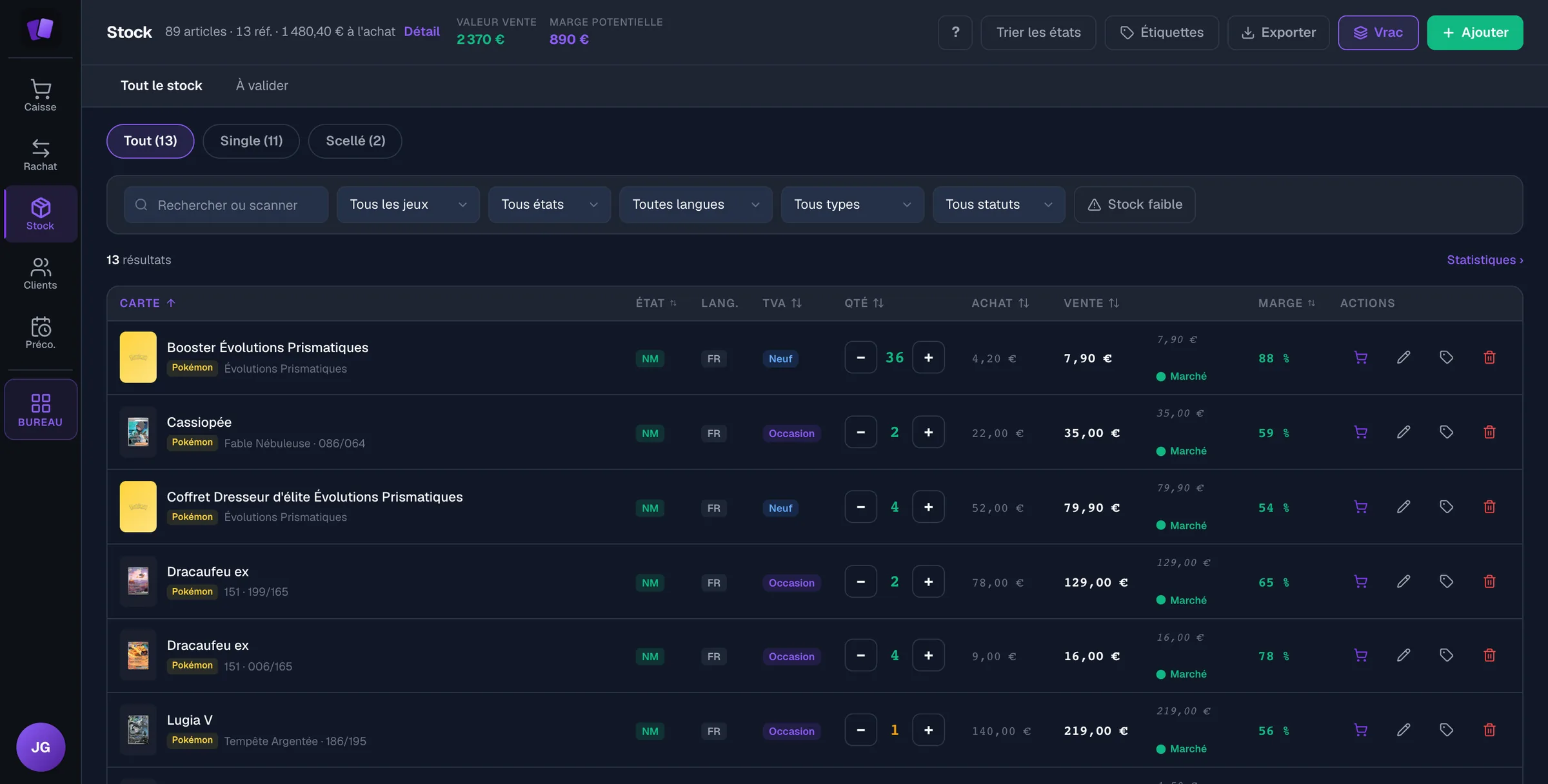
Value. References, items, purchase and sale value, potential margin: your stock on one line.
Sealed product, single cards, graded cards, accessories and goodies, new or second-hand.
Over 400,000 cards across seven games: Pokémon, Magic, Yu-Gi-Oh!, Lorcana, One Piece, Riftbound and Naruto.
It rings up sales at the till and receives goods into stock.
Code 128 and price, printed from the browser, or over direct USB on a Mac with Chrome or Edge.
PSA, BGS, CGC, PCA, CCC, ACE: cards missing a certificate number are listed first. Selling a graded card stays open to every plan.
Cards a customer leaves with you to be graded: intake, sending by batch, tracking until they come back. The card stays the customer's.
A selling item down to zero, dormant stock, margin too low, pre-orders, a till left open.
Ordered, received, late, and how quantities are allocated on arrival.
Excel or CSV, columns recognised, duplicates merged; the customer file comes back with its cards and points.
Loyalty, pre-orders and tournaments, gathered on a calendar the whole team can see.
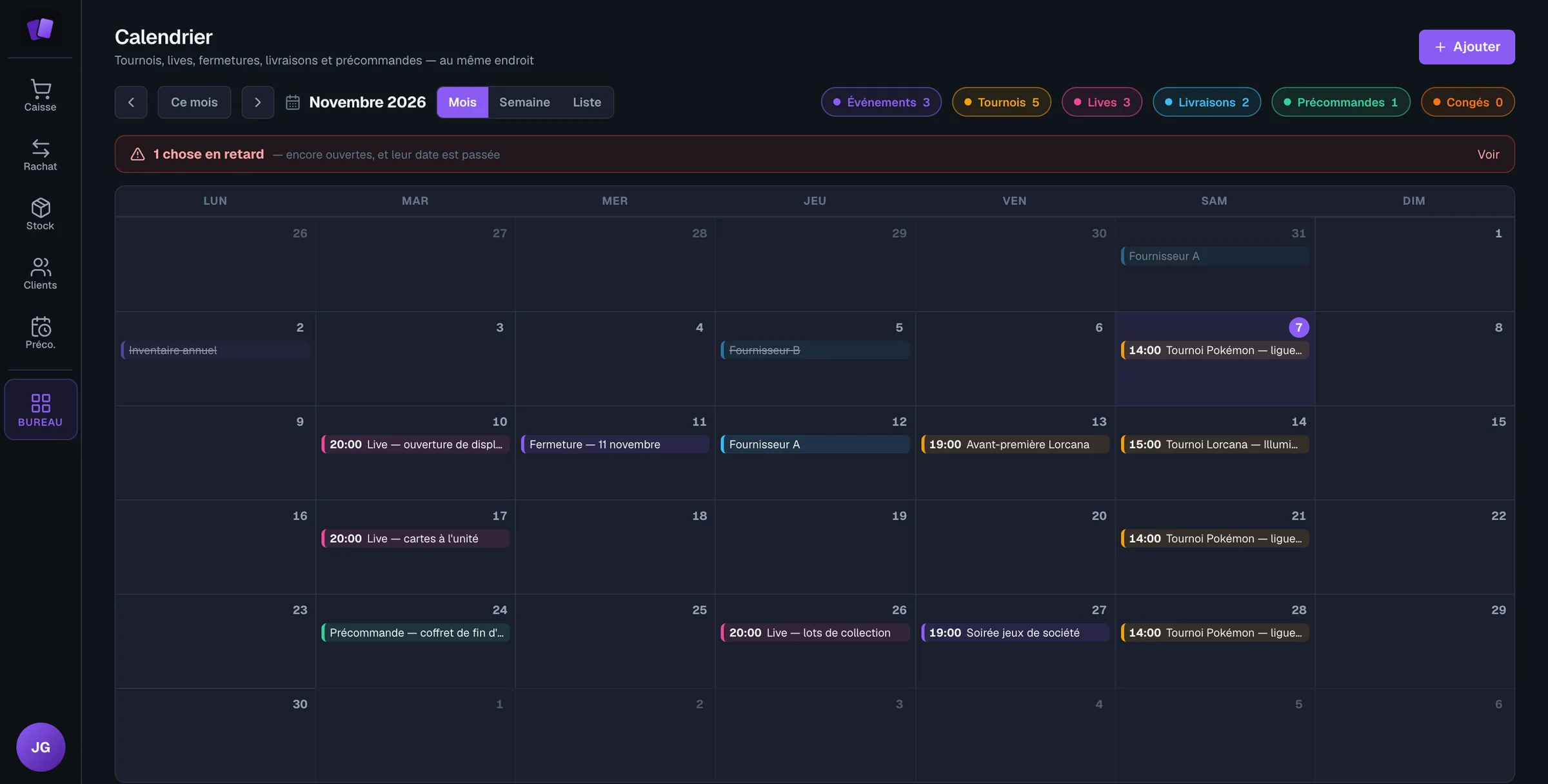
The month. The whole month on one screen, with arrows to move on to the next.
Points, tiers and vouchers; a printed card, or a link the customer adds to their phone's home screen.
You set the price, the length and the discount; the card is sold at the till, and its discount applies by itself to the member's purchases while it is valid.
Store credit or discount vouchers, used at the till with no double use, balance kept.
Reservations and expected quantities tracked before products are released, then handed over at pick-up.
Sign-ups, entry fees added to the till's cart, Swiss rounds, podium and prizes, lists in CSV.
Tournaments, lives, deliveries, pre-orders and closures on one calendar, with what is overdue.
Schedules, leave and everyone's permissions live in the shop's software.
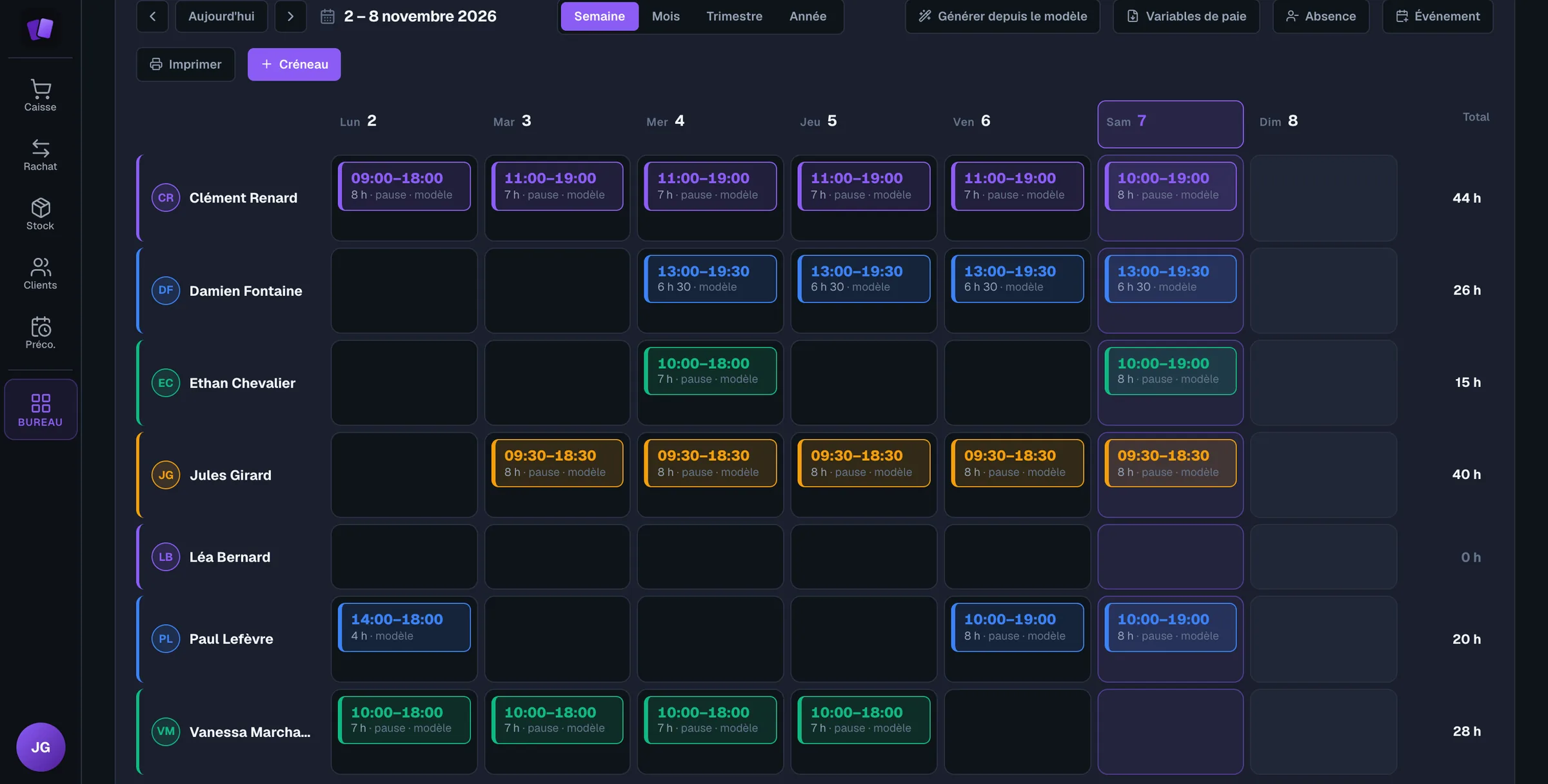
Week. Each shift shows its hours and its break, day by day.
By week, month, quarter or year, generated from a template week then adjusted day by day.
Request, approve or decline, with balances and hour counters kept up to date.
An expiring link, and a calendar file each person opens on their phone.
The month's hours and absences exported as CSV for the accountant.
Five roles, eight adjustable permissions, and switching employee in two taps on the same till.
A one-time code on top of the password, required for a manual closing and the tax exports.
The software prepares payroll inputs for the accountant; it does not run payroll.
VAT is computed sale by sale, and the documents an inspection asks for come out of the software.
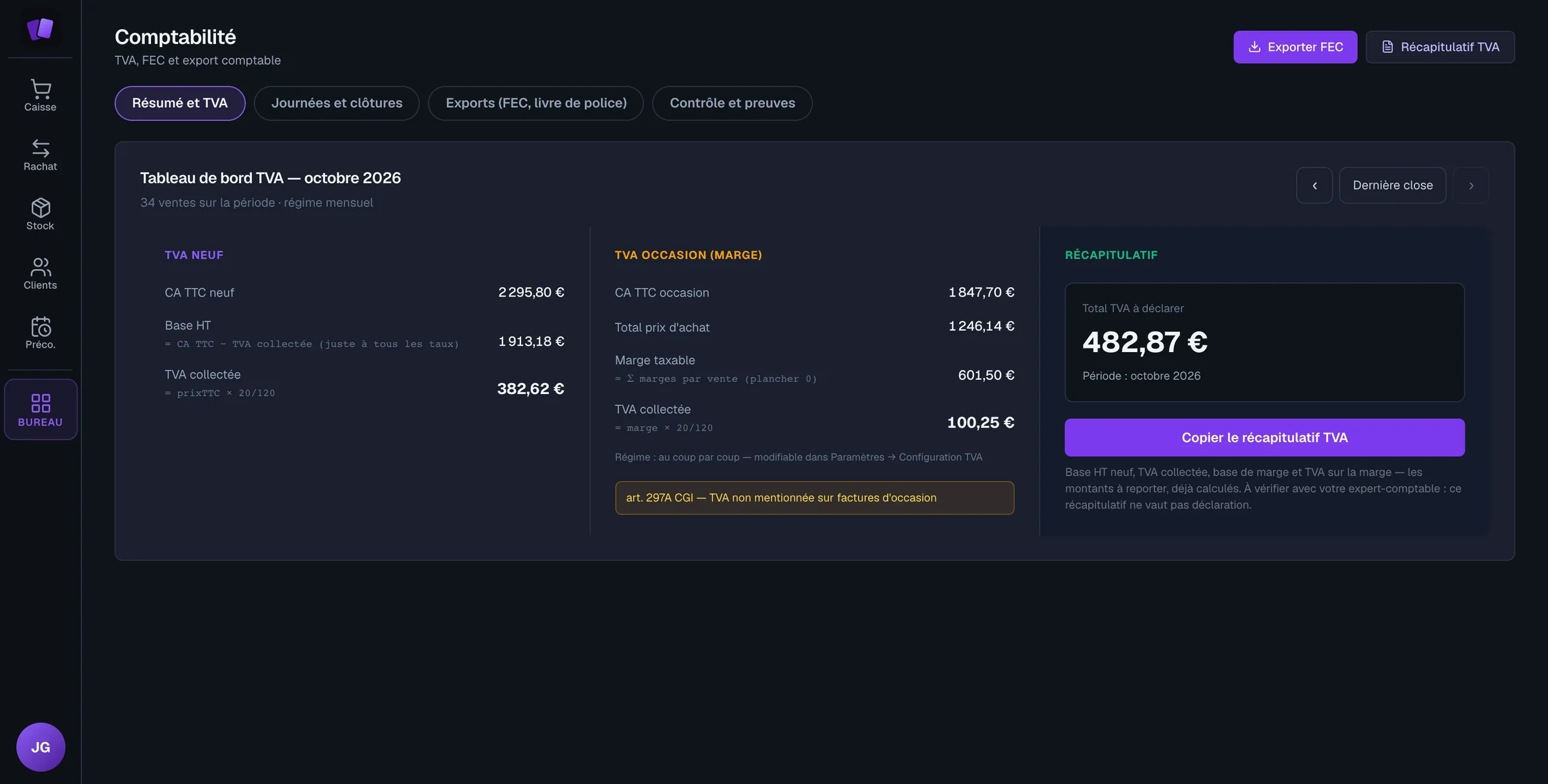
VAT on new. New items: 20% VAT on the selling price, with the month's net base and collected VAT.
20% VAT on the price of new items, on the margin alone for second-hand (French art. 297 A); the monthly table is ready to copy.
Closing for each till, reprint of any Z, and an extra Z when a sale made offline arrives after the closing.
Sales, buy-backs, sessions and closings, with a one-click integrity check.
Yearly archive, records to hand over in a tax inspection, printable sheet for an on-site check.
Revenue, margin, best sellers and cash position, in real time. The activity report is laid out on an A4 sheet, to print or save as a PDF for the accountant.
For an account running several shops: each shop's sales, revenue and VAT, gathered on the dashboard.
The shop's sales in one table, by period. Importing online sales is not available at the moment.
Cash, cheque or transfer received outside a till sale.
The French accounting entries file, on a chart of accounts the shop can configure.
Business-to-business invoices generated in Factur-X format. Their transmission through an approved platform is on the roadmap.
Echo TCG takes no percentage of what you sell, in store or anywhere else. A fixed subscription, and that's it.
Fixed subscription, from €49 per month
You export your stock from your old software, Echo TCG recognises the columns, you check, and everything comes over. Nothing to re-key. Included from the Pro plan.
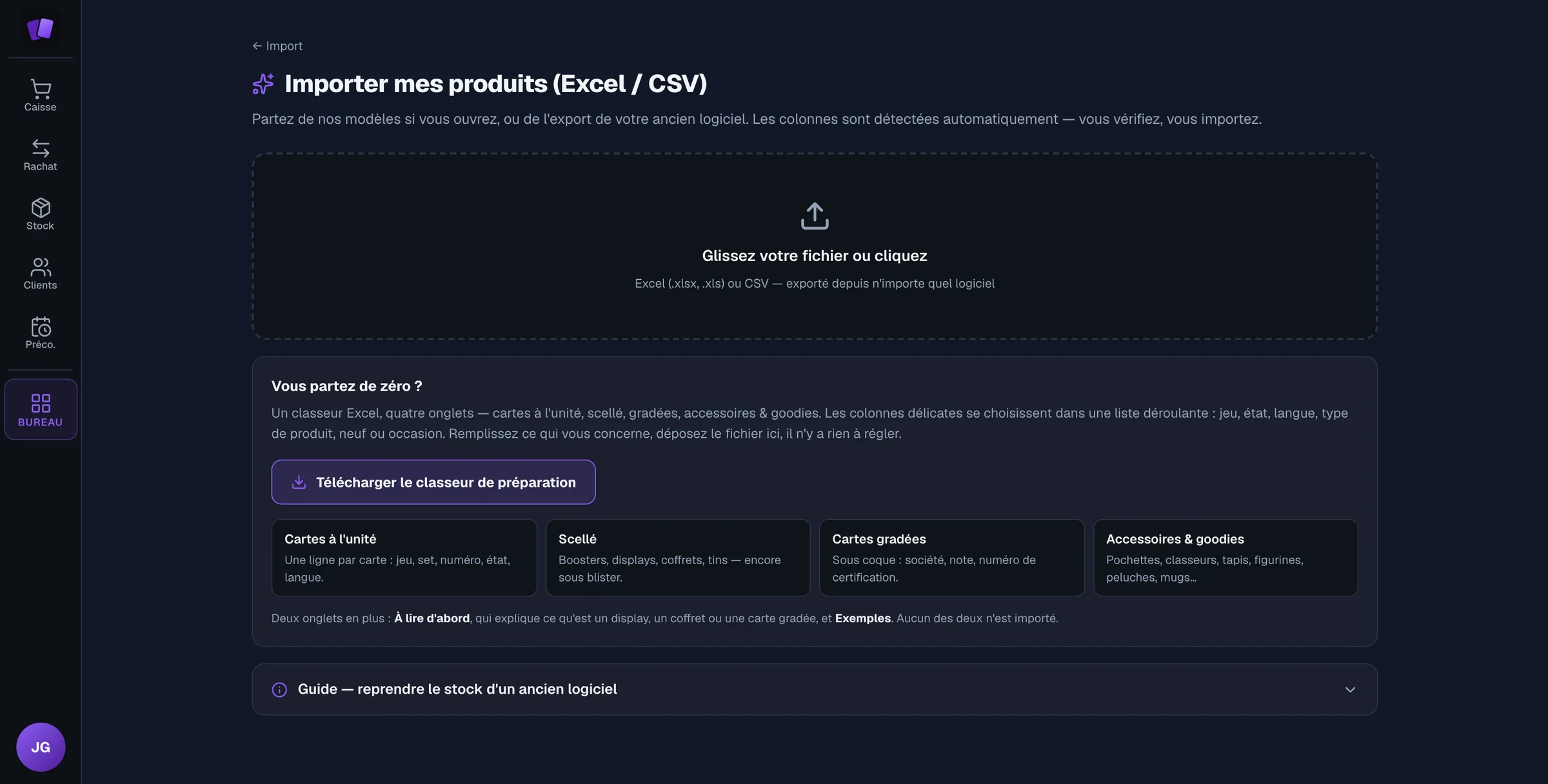
The file. Your old software's export, in Excel or CSV: drop it here as it is.
New or second-hand, it all goes into the same stock.
What is planned, then what is only under study, with no date.
Factur-X invoices are already generated; sending them through an approved platform is planned before the September 2027 obligation to issue them.
Automatic reconciliation of takings against the shop's business account.
Keep an eye on the shop, inventory and sales from a phone.
Under study, no date
The amount goes to the card terminal by itself, with no double entry. Meanwhile, your current terminal works as it is, next to the till.
Under study, no date
Online sales import, then Echo TCG updating your website's stock, with delisting when out of stock.
This list exists so the tool is not recommended to someone it would disappoint. The needs below are NOT covered today:
Echo TCG does not replace Shopify or WooCommerce, and does not sync with them automatically. Online sales file import is not currently available.
Official results go through the publishers' own tools (TOM and Play! Tools for Pokémon, EventLink for Magic, Bandai TCG+ for One Piece, Ravensburger Play Hub for Lorcana), none of which offers an open API. Echo TCG handles sign-ups, entry fees and prizes, then exports the lists as CSV.
It produces the French FEC export, margin VAT, the police register and Z closings; it does not replace an accountant or bookkeeping software.
It is web software: it opens in the browser of a tablet, a computer or a touch terminal.
Margin VAT (French art. 297 A) and the police register (art. 321-7 of the French Penal Code) are French rules, and the software is built around them.
Publisher programme, preparing the event, entry fee, prizes and insurance: what a shop must settle before its first tournament.
5 minBoard games, new cards and bought-back cards in one sale: what till software must handle, and how to check it really does.
5 minThe columns to create, the formulas to use and the limits of a spreadsheet for a card stock, before moving to software.
5 minThree sources of margin, three behaviours: worked assumptions to understand sealed products, single cards and buy-backs, and what VAT takes out.
5 minA member of the team shows you the software and answers your questions. No commitment.