Margin VAT on second-hand Pokémon cards (art. 297 A)
How French margin VAT works for buying and reselling second-hand cards: the calculation base, the mandatory invoice wording, and how to automate it in a shop.
By Paul Hilmarcher, founder of Echo TCG, working hand in hand with card shops.
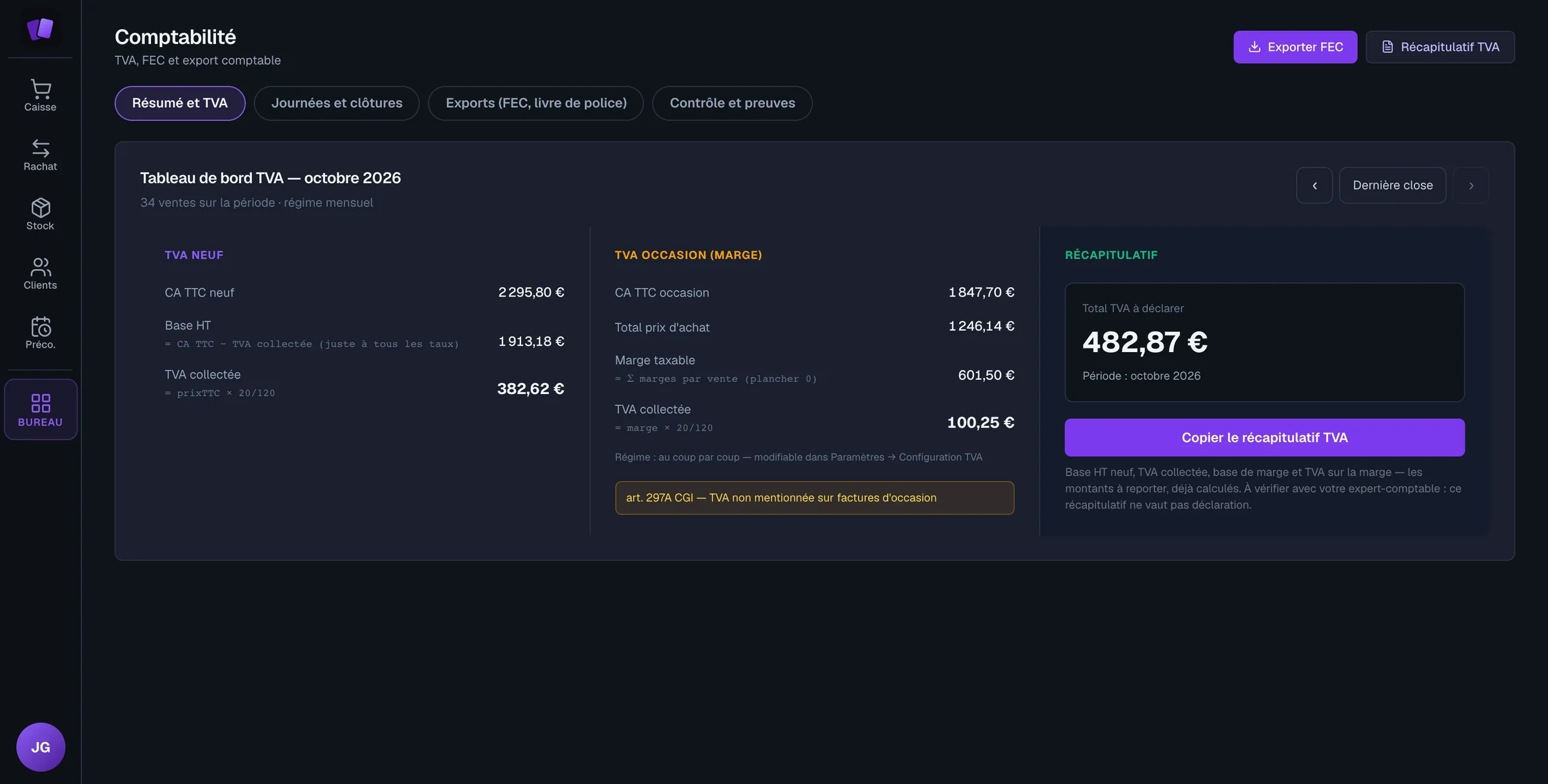
Margin VAT is the French VAT scheme for second-hand goods (article 297 A of the French tax code). When a shop resells a card bought from a private individual, VAT is charged on the margin made, not on the full selling price: (selling price − purchase price) × 20/120, for a 20% rate. The invoice does not show this VAT and carries the wording “Régime particulier – Biens d'occasion” (margin scheme – second-hand goods).
- Example: a card bought back for €40 and resold for €70 leaves a €30 margin, that is €5 of VAT (30 × 20/120), against €11.67 if VAT were charged on the selling price.
- New card bought from a distributor: 20% VAT on the selling price.
- Second-hand card resold at a loss: no VAT on that sale, when the margin is calculated transaction by transaction.
- Sealed product bought back from a private individual: it may follow the margin scheme, under the conditions of the ruling of 19 August 2026.
- Business buyer: they cannot deduct the VAT, since it does not appear on the invoice (art. 297 E of the French tax code).
How margin VAT is calculated
The margin is the difference between the selling price and the purchase price of the card. VAT is extracted from that margin at the applicable rate: margin × 20 / 120 (for a 20% rate). If resold at a loss, no VAT is due on that sale; under the global method (art. 297 A, II of the French tax code), the loss reduces the period's taxable margin, and the excess carries over to the following periods. Your accountant will tell you which method applies to your shop.
- New card: standard 20% VAT on the selling price.
- Second-hand card (buyback): margin VAT = (sale − purchase) × 20/120.
- Second-hand graded cards: same margin logic.
The mandatory invoice wording
Sales under the margin scheme do not show VAT (art. 297 E of the French tax code). The invoice carries the wording “Régime particulier – Biens d'occasion” (margin scheme – second-hand goods).
Why automate it
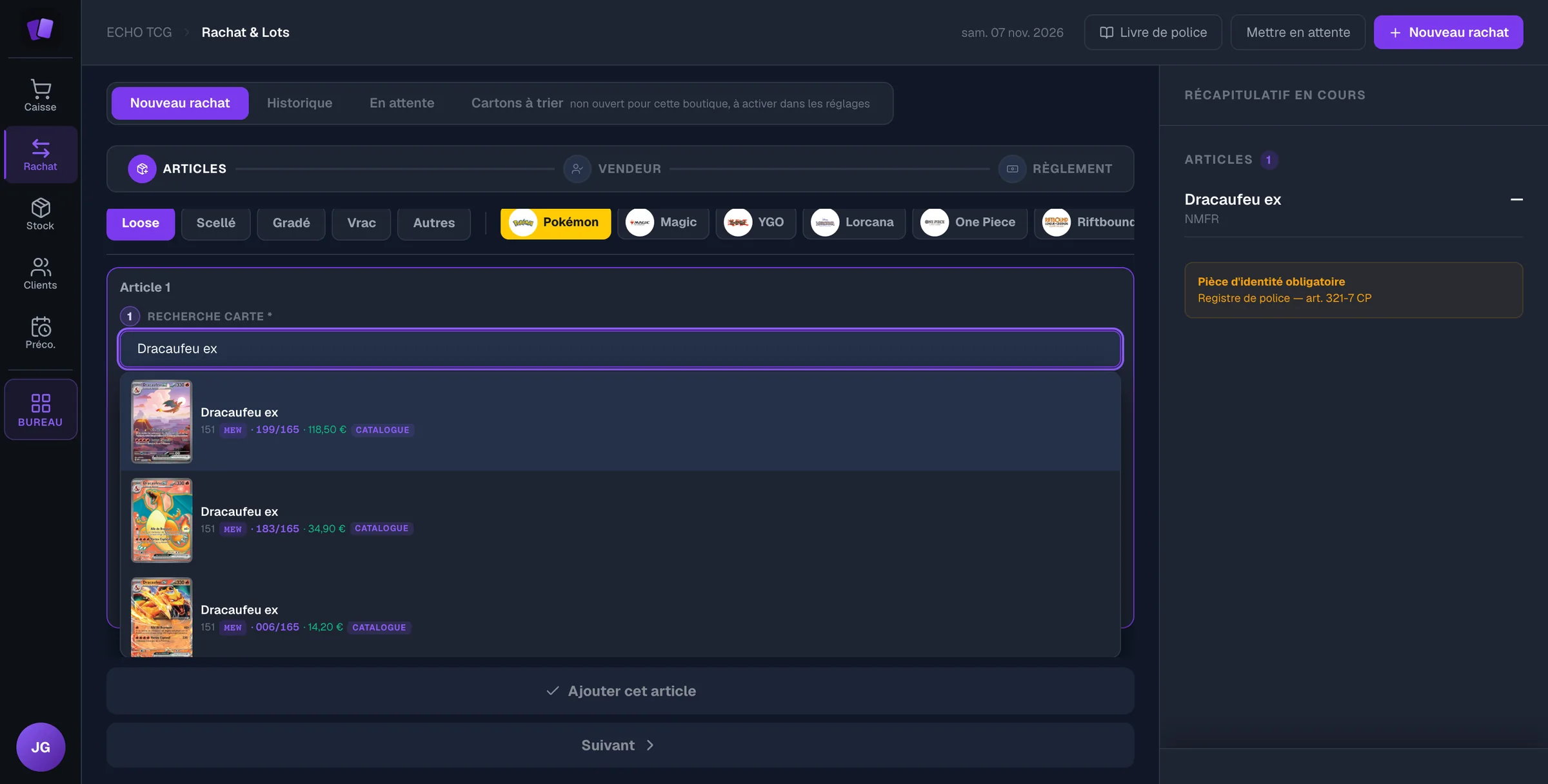
Manually tracking the purchase price of every bought-back card, then computing the margin at resale, is slow and error-prone. Echo TCG, point-of-sale and management software, keeps the purchase price of every bought-back card, applies margin VAT at sale and prints the “Régime particulier – Biens d'occasion” wording on the relevant invoices. Echo TCG's features, prices and limits are set out on a single page.
A worked example
A card bought back for €40 from a private seller and resold for €70 leaves a €30 margin. The VAT due on that sale is 30 × 20/120 = €5. Calculated on the sale price, it would have been 70 × 20/120 = €11.67.
Sealed product bought from a private seller
A ruling published on 19 August 2026 states that an item never used, still in its original packaging, can be a second-hand good: what matters is that it was bought from a private individual who bore the VAT themselves, and that it remains usable. For a card shop, that is typically a sealed booster or box bought back from a customer, on one condition: the seller is a private individual, who could not deduct the VAT, unless the scale or repetition of the supplies makes them a professional in fact (BOI-RES-TVA-000270). The police register proves their identity, not the absence of deductible VAT. The same product bought new from a distributor remains subject to VAT on the sale price.
What counts as the purchase price
The purchase price used is what the shop actually paid the seller for that item. It must be justifiable card by card: the police register records the price paid and the seller's identity, which serves as proof. A lot bought in bulk is split between its cards so that each resale has its own purchase price. The splitting method is chosen with your accountant, then kept from one buyback to the next.
Transaction by transaction, or the global method
There are two ways to calculate the margin. Transaction by transaction, the margin on each card is calculated separately and a negative margin is brought back to zero: it does not reduce the VAT on another sale. Under the global method, sales and purchases are added up over a period, and the loss reduces the period's taxable margin, the excess carrying over to the following periods (art. 297 A, II of the French tax code). This second method is framed by the text: the choice and its conditions should be checked with a professional before applying it.
New, second-hand, sealed: knowing which category each sale belongs to
The scheme does not depend on the type of card, but on where the item came from and who sold it. A new product bought from a distributor follows standard VAT on the selling price. A card bought back from a private individual follows the margin. A sealed product bought back from a private individual may follow the margin under the conditions of the ruling quoted above. New accessories (sleeves, binders, boxes) stay at standard VAT. The sales channel changes nothing: a second-hand card sold during a Whatnot live follows the same scheme as in the shop. Knowing which category each sale falls into avoids discovering a mistake at filing time.
An invoice with no visible VAT: the consequence for the buyer
Because VAT does not appear on the invoice (art. 297 E of the French tax code), a professional buyer cannot deduct it. A shop that resells to another business must take this into account in the price it offers. To know when to issue an invoice and when a receipt is enough, see the article on invoice or receipt in a card shop.
Before opening, the tax diagnostic shows whether the shop will probably be under the VAT exemption (franchise en base), in which case the margin question arises differently; it is a general orientation, not personalised advice.
Official sources
- Article 297 A of the French Tax Code (Légifrance, in French): the margin scheme and its tax base
- Articles 297 A to 297 G of the French Tax Code (Légifrance, in French): the whole scheme, including the ban on showing VAT (art. 297 E)
- Article 242 nonies A, Annex II of the French Tax Code (Légifrance, in French): the “Régime particulier – Biens d'occasion” mention
- BOFiP, BOI-TVA-SECT-90 (in French): second-hand goods, taxation principles
- BOFiP ruling of 19 August 2026 (in French): an unused item can be a second-hand good
This article is informational and does not replace your accountant's advice.
Frequently asked questions
- How do I calculate VAT on a second-hand card I bought back?
- VAT is charged on the margin, not the full price: margin × 20/120, i.e. (sale price − purchase price) × 20/120 for a 20% rate.
- What wording must appear on a margin-scheme invoice?
- VAT does not appear on the invoice (art. 297 E of the French tax code), which carries the wording “Régime particulier – Biens d'occasion” (margin scheme – second-hand goods).
- Is VAT due if I resell a card at a loss?
- Not on that sale, if the margin is calculated transaction by transaction: the margin is negative and no VAT is due. Under the global method (art. 297 A, II of the French tax code), the loss reduces the period's taxable margin, and the excess carries over to the following periods.
- Is a sealed product bought back from a private individual a second-hand good?
- It can be. A ruling of 19 August 2026 states that an item never used, still in its packaging, can be a second-hand good if it was bought from a private individual who bore the VAT, unless the scale or repetition of the supplies makes the seller a professional in fact (BOI-RES-TVA-000270). The police register proves the seller's identity, not the absence of deductible VAT.
- Can a professional buyer deduct the VAT on a card sold under the margin scheme?
- No. VAT does not appear on the invoice (art. 297 E of the French tax code), so there is nothing for the buyer to deduct.
Echo TCG: the POS and management software for card shops.
From €49 a month, with no commission on your sales. See pricing