Till software for a game and card shop
Till software for a board game and card shop: standard and margin VAT in one sale, EAN barcodes, buy-backs with a police register, returns and closing.
By Paul Hilmarcher, founder of Echo TCG, working hand in hand with card shops.
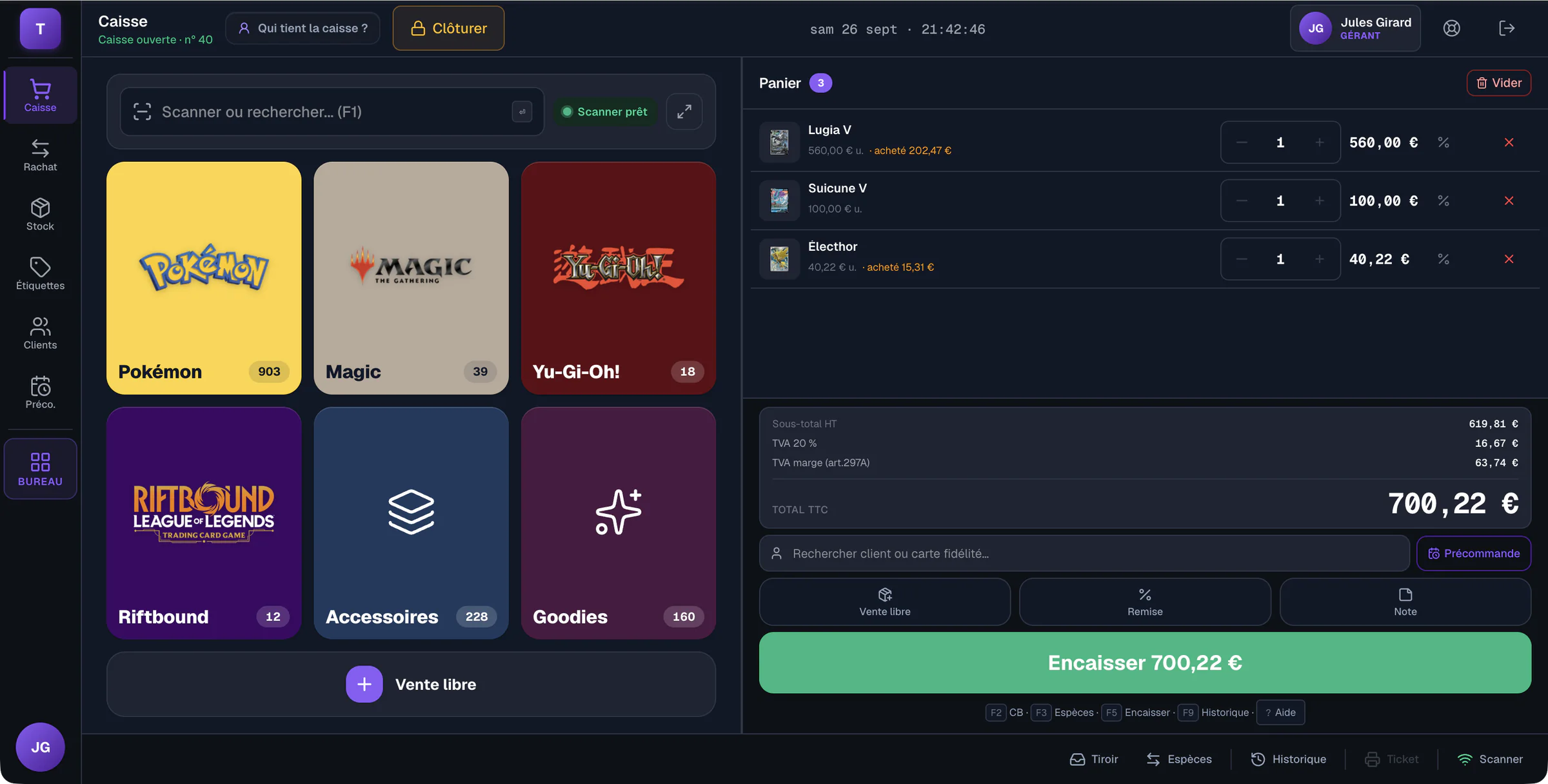
A game shop that adds collectible cards, or a card shop that opens a board-game section, soon finds that its till must do more than add up prices. The same customer leaves with a new game box, a booster and a card bought back the week before: three products, two VAT treatments, one receipt. This article describes what till software must be able to do for this mixed trade and how to check, before committing, that it does.
Two VAT treatments on one receipt
A product bought new from a distributor is resold with VAT at the standard rate on the selling price. A second-hand card bought from an individual falls under the margin scheme (article 297 A of the French tax code): VAT applies only to the difference between selling price and purchase price. A mixed shop therefore lives with both, sometimes in the same basket. The article on margin VAT details the calculation and the “Régime particulier – Biens d'occasion” wording to put on the invoice.
What you expect from the till: each line carries its own treatment, the seller does not have to choose at every sale, and the closing (Z) and the month-end summary separate the two bases. On the receipt, the VAT of new items is shown; the second-hand line shows no VAT and carries the wording “Régime particulier – Biens d'occasion”. Echo TCG applies VAT at each item's rate (20% for games and sealed products) on the price of new items and on the margin alone for second-hand ones, line by line; the monthly table is ready to copy. Always ask to see a mixed receipt before choosing a tool, and have your accountant check how your own case is treated.
Barcodes: manufacturer EAN and shop labels
Board games, accessories and many sealed products carry an EAN barcode printed by the manufacturer. Reading it at the till avoids searching for the item by hand and saves time on receiving goods. A good till keeps this code as it is: an item's record in Echo TCG keeps the manufacturer's EAN13, and the shop's own code never replaces it.
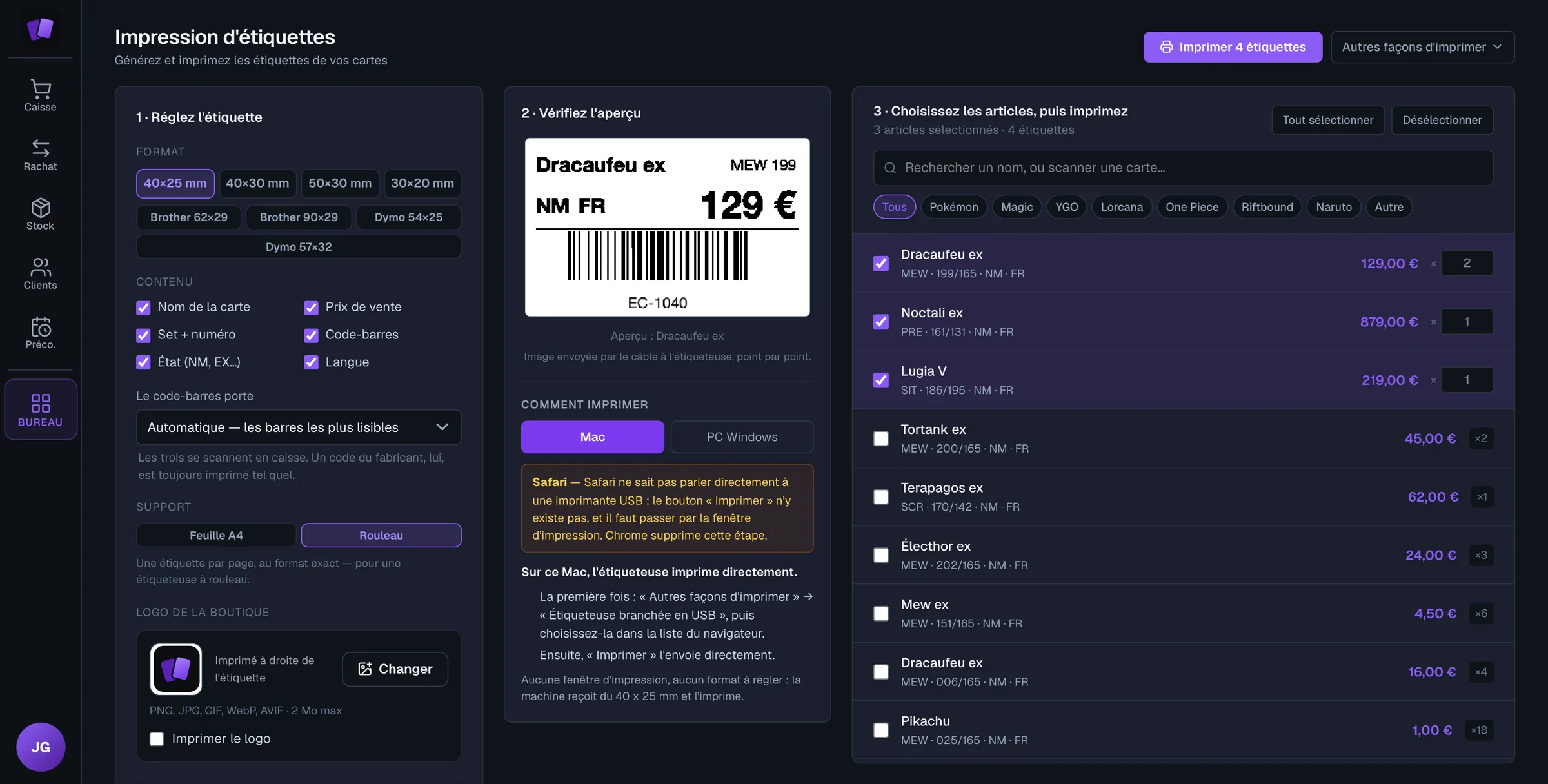
For items that have none, such as a single card, the shop prints its own labels (Code 128 and price), from the browser or over direct USB on a Mac with Chrome or Edge. The scanner rings up sales at the till and also receives goods into stock: receiving a carton of games then means scanning, not typing. The guide on till hardware for a card shop details the choices of scanner and printer.
Pre-orders and deposits
Games and card expansions are often reserved before release. A pre-order with a deposit only applies to a new item: a second-hand card under the margin scheme cannot be reserved with a deposit. Whatever the tool, the deposit is tracked apart from the final sale, so that it neither inflates the day's figure nor vanishes at pick-up. The article on pre-orders and releases in a shop explains how to frame the rules for reservation and cancellation.
Buying back cards in a game shop
If the shop buys cards from individuals, it must keep the police register (article 321-7 of the French Penal Code) and keep for each card the price paid, which then serves as the basis of the margin. Buy-back is a flow of its own: seller identity, item description, price, payment. Echo TCG chains the items, the seller and the payment, fills the police register at each buy-back and allows a split payment, one part in cash and the rest by transfer, cheque or store credit. For the required entries, see the guide on the police register, and for setting the price, the one on buy-back pricing.
Returns, discounts and closings
A game shop handles returns: a box exchanged, a faulty product. A sale is never erased in Echo TCG: it is reversed, with discounts refunded pro rata. Line discounts need a reason, and above the shop's threshold a manager approves. Each till has its own closing, and cash sales keep going offline, numbered and sealed on the till then sent when the connection returns; buy-backs and store credit need the network. These mechanisms touch the regulation of tills: for NF525, read the dedicated article, NF525 in a card shop.
Questions to ask before choosing
- Does it show a receipt mixing new and second-hand items (VAT shown on new, none visible on second-hand) and a closing that splits the two bases?
- Does it keep the manufacturer's EAN code and let you print your own labels?
- Does it let you track reservations of new items and their cancellation rules?
- Does it fill the police register at the time of the buy-back rather than afterwards?
- Are returns reversals, and can sales continue without a network?
- Is the price readable, per shop, with no commission on sales?
The guide on choosing till software offers a broader checklist, and the features page lists, module by module, what Echo TCG does and the plan that unlocks it. To see a mixed receipt on a demonstration shop, you can book a demo.
This article is informational and does not replace your accountant's advice.
- Article 297 A of the French Tax Code (Légifrance, in French): the margin scheme and its tax base
- BOFiP, BOI-TVA-SECT-90 (in French): second-hand goods, taxation principles
- French Penal Code (Légifrance, in French): article 321-7 and articles R321-1 to R321-8, the register of second-hand movable goods
- impots.gouv.fr (in French): who is concerned by the obligation to hold secure till software
Frequently asked questions
- Can one sale mix a new game and a second-hand card?
- Yes. Each line follows its own treatment: the new game is taxed at the standard rate on its selling price, the card bought from an individual on its margin alone. On the receipt, the VAT of the new item can be shown; the second-hand line shows no VAT and carries the wording “Régime particulier – Biens d'occasion”. The closing (Z) must split the two bases, without the seller having to choose.
- Does the scanner read board-game barcodes?
- Echo TCG's scanner rings up sales at the till and receives goods into stock. An item's record keeps the manufacturer's EAN13 code as printed; the shop's own code never replaces an existing EAN.
- Can you reserve a second-hand card with a deposit?
- No. A pre-order with a deposit only applies to a new item: a second-hand card under the margin scheme cannot be reserved with a deposit. Set the rules for reservation and cancellation in writing.
- Do you need a police register if you only buy back cards?
- The police register covers any purchase of second-hand goods from individuals for resale, cards included. A shop that buys back only cards is bound by it like any other.
- Which plan suits a game and card shop?
- The till, stock, buy-back with police register and margin VAT are open to every plan. Customers and loyalty, tournaments and the dashboard start at the Pro plan. Prices are on the pricing page.
Echo TCG: the POS and management software for card shops.
From €49 a month, with no commission on your sales. See pricing