Card shop margin: boosters, singles and buy-backs
Working out a card shop's margin: boosters, single cards and buy-backs, markup, margin VAT and discounts. With fictional examples to adapt to your prices.
By Paul Hilmarcher, founder of Echo TCG, working hand in hand with card shops.

Saying a card shop “makes margin” means almost nothing: the booster, the single card and the buy-back behave quite differently, and VAT applies to them in different ways. An owner who looks at a single average percentage cannot see where the money comes from, nor what makes them lose it. This article sets out the definitions, then goes through three worked examples. These figures are textbook assumptions meant to show the method: they reflect no market price, and you must replace them with your own purchase and selling prices.
The words: gross margin, markup, margin rate
An item's gross margin is the difference between its selling price excluding tax and its purchase price excluding tax; for a second-hand good, it is the purchase price actually paid to the seller. It then covers your costs (rent, wages, insurance, bank fees) and your profit. Two percentages circulate and get confused:
- markup relates the margin to the purchase price: buying at €3 and selling at €3.75 excluding tax gives €0.75 of margin, or 25%;
- margin rate relates the same margin to the selling price excluding tax: €0.75 on €3.75, or 20%.
For the same transaction, the margin rate is always lower than the markup. Neither is “the right one”: pick one, write it at the top of your tables and compare only figures computed the same way.
First case: sealed products
Textbook assumption: a booster bought for €3.00 excluding tax from a distributor, sold for €4.50 including tax. The product is new, so VAT is at the standard rate on the selling price: €4.50 including tax is €3.75 excluding tax. Gross margin is €0.75, a markup of 25%.
Sealed products have two characteristics. The margin per item is thin, so it is very sensitive to anything that erodes it. And turnover is fast when the product is in demand: the margin is earned through volume. A 10% discount drops the price to €4.05 including tax, or €3.375 excluding tax: the margin becomes €0.375 and the markup 12.5%. A “kind” discount has halved the margin. That is the reason for a discount threshold and a reason on each line.
Second case: a single card bought back
Textbook assumption: a card bought back for €7 from an individual and sold for €10 including tax. It is a second-hand good: VAT applies only to the margin (article 297 A of the French tax code). The margin including tax is €3, the VAT due is 3 × 20 / 120 = €0.50, and the margin net of VAT is €2.50. Relative to the purchase price, it represents about 36%.
If VAT had wrongly been applied to the selling price, you would have subtracted 10 × 20 / 120 = €1.67, and the apparent margin would have fallen to €1.33. Knowing which scheme applies is not an accounting detail: it is what separates a real margin from one you believe in. The article on margin VAT details the calculation and the options.
The single card has the opposite profile to sealed products: a wider margin per item, but slower turnover, because a specific card waits for the right buyer. The cash tied up in stock is the real hidden cost of this section.
Third case: the buy-back, a margin decided at purchase
In the previous example, the margin was decided the moment you said “€7” to the seller. An over-generous buy-back cannot be recovered at the till. That is why setting the price, checking the condition and tracking each copy's purchase price matter more than any setting of the selling price. The method is in the article on buy-back pricing, and the question of what percentage to pay finds there a method rather than a figure.
A buy-back also costs time: identifying the card, judging the condition, filling the police register, putting it away. That time is a cost to count in the margin you need, especially on lots made of common cards.
An accessory, for comparison
Textbook assumption: a sleeve bought for €1.00 excluding tax, sold for €2.40 including tax, or €2.00 excluding tax. The margin is €1.00, a markup of 100% and a margin rate of 50%. Accessories are new goods at standard VAT like sealed products, but with more comfortable unit margins: that is why a well-run accessories section can support the result of a shop whose sealed margin is thin. This reading remains an assumption: check it against your own invoices.
Margin is not enough: turnover and costs
A wide margin on an item that sits ten months in the case earns less than a thin margin on one that sells every week. Always relate margin to the cash it ties up: dormant stock is frozen cash. Then subtract what is not on the price tag: rent, wages, insurance, bank fees and shrinkage, meaning losses from theft, mistakes or damaged cards. No typical figure is given here, because these costs change from one shop to another; the business plan is the right place to set them down.
Steering your margin day to day
- Calculate margin by family (sealed, single cards, accessories) rather than as a general average.
- Record the purchase price of each copy bought back: without it, neither the margin nor margin VAT can be calculated.
- Set a discount threshold, with a reason, and review the month's discounts.
- Spot dormant stock and decide: lower the price, bundle, stop restocking.
- Review your selling prices at the market's pace: see the guide on card selling prices.
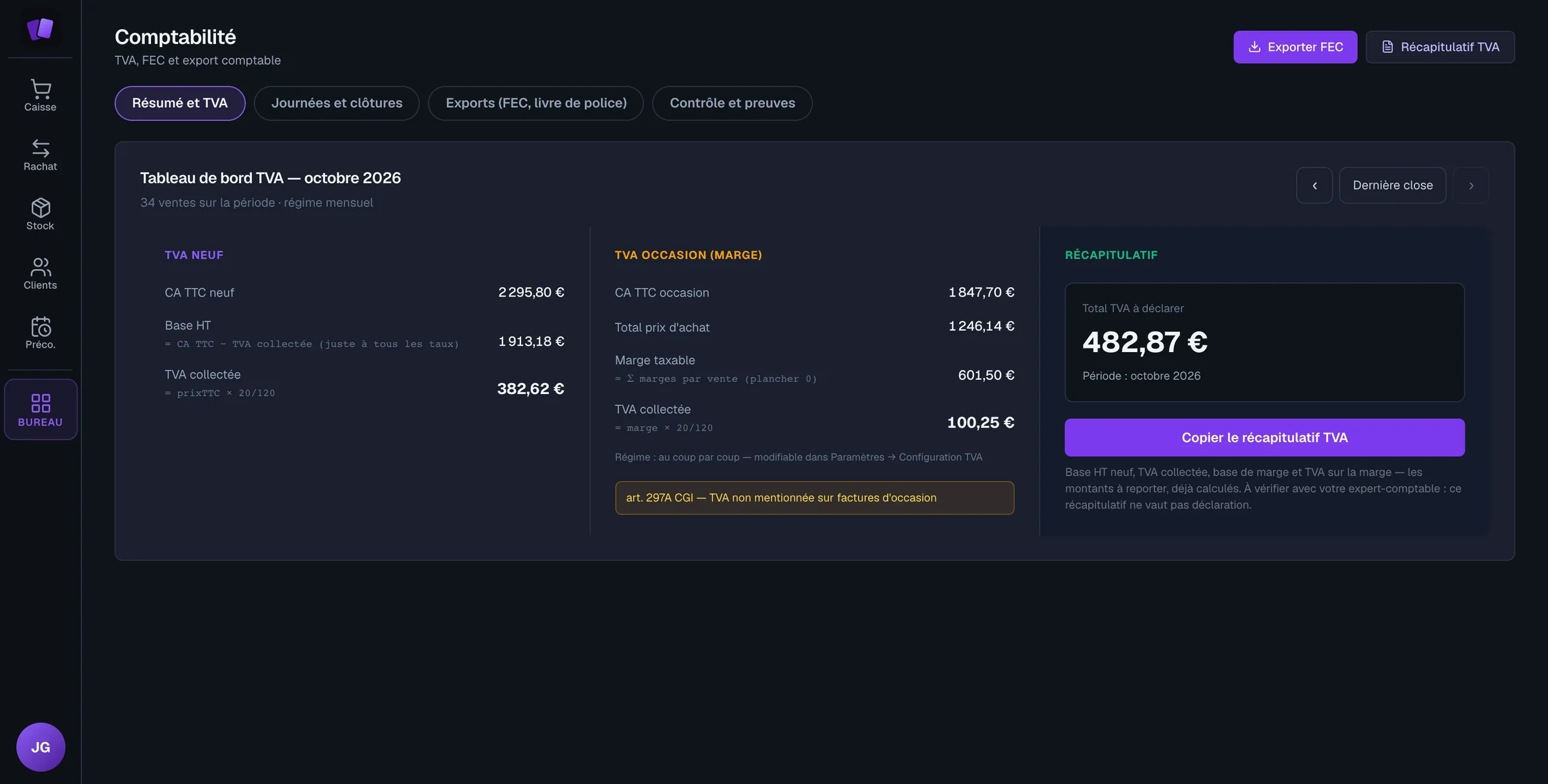
In Echo TCG, stock shows each item's purchase price, selling price and margin, and alerts flag an item with a margin that is too low, dormant stock or a selling item down to zero. The dashboard (Pro plan) brings together revenue, margin, best sellers and cash position. Line discounts need a reason and, above a threshold the shop sets, a manager's approval. The detail is on the features page.
This article is informational and does not replace your accountant's advice. The amounts are fictional.
Frequently asked questions
- What is the difference between markup and margin rate?
- Markup relates the margin to the purchase price; margin rate relates it to the selling price excluding tax. For the same transaction, the second is always smaller. Choose one convention and keep it.
- Should margin be calculated including or excluding tax?
- Excluding tax for a new product: the VAT you collect is not yours. For a second-hand card under the margin scheme, VAT is calculated on the margin (margin × 20 / 120 at the 20% rate) and subtracted from that margin.
- What margin should you aim for on boosters?
- There is no universal figure. Margin depends on your purchase terms, your selling prices and your discounts; only your own calculation, on your own invoices, is reliable.
- Can a discount really wipe out the margin on a sealed product?
- Yes, because margin per item is thin: in the article's example, a 10% discount takes the markup from 25% to 12.5%. Set a discount threshold and require a reason.
- Where do you read your margin in Echo TCG?
- Stock shows the purchase price, selling price and margin of each item. The dashboard (Pro plan) gives revenue, margin and best sellers, and alerts flag a margin that is too low.
Echo TCG: the POS and management software for card shops.
From €49 a month, with no commission on your sales. See pricing