Setting selling prices in a card shop
Set selling prices for singles, sealed products and graded cards using relevant comparisons, clear labels and regular reviews across your shop and listings.
By Paul Hilmarcher, founder of Echo TCG, working hand in hand with card shops.
What should selling prices in a card shop be based on?
Base selling prices on comparable evidence, the characteristics of your products and the actual conditions of sale. A card name or the popularity of an expansion does not provide enough information for a decision. Identify what you are offering, examine the available references and consider the requests you encounter in the shop. Staff should be able to explain the chosen price clearly to a buyer without relying on the impression created by an isolated listing.
Keep the inputs separate: acquisition cost, market evidence, preparation work and the time a product remains available. They inform a commercial decision without creating an automatic formula. The guide to setting card buyback prices explains the reasoning when purchasing stock; this guide concerns the offer made to the buyer. Keep a brief note identifying the source, the date you consulted it and the characteristics that affected your choice. That record lets a colleague understand a decision without reconstructing the research from memory.
How do you identify a single card precisely?
Identify condition, language, edition and finish before comparing a card with other copies. Record its name, printed number and expansion, then establish the exact version. Similar artwork may appear in a reprint or a different finish. A mistaken identification can carry through to the label, the listing and the explanation given to the customer. Resolve uncertainty before making the item available, especially when neighbouring versions look similar inside their protective sleeves.
Examine the front, back, corners, edges and surface under suitable lighting. Describe visible defects using consistent terms throughout the shop. Cards stored together should not receive the same condition description simply because they share a binder page. State the language clearly too: demand for a particular version does not establish demand for every alternative. The guide to selling singles and sealed products helps organise these product families without mixing their references or overlooking the differences a buyer needs to understand.
How should Cardmarket and successful eBay sales be used?
Use Cardmarket market values as a reference, then compare them with successful eBay sales of genuinely equivalent cards. Distinguish active listings from completed transactions. A seller’s asking price does not establish that a buyer accepted it. Check the period covered, stated condition, language, edition and finish. Exclude bundles and listings whose contents do not match the copy you are preparing, even when the photograph initially appears to show the same card.
Read the sale conditions as well: a reference involving delivery should not be compared blindly with collection from a shop. If the amount actually accepted or the precise condition is unclear, record that limitation. Missing evidence should remain missing rather than becoming an assumption. When comparable sales are scarce, explain why the estimate is uncertain and arrange to revisit it. Local requests and your own completed sales add useful context, but an isolated enquiry does not establish a settled market value or predict the next buyer’s decision.
How should graded cards be priced?
Compare graded cards with copies matching the edition, language, grading company and grade. The ungraded card reference is insufficient because the assessment and holder form part of the product being offered. Record the holder’s details, including the certification reference, so the research remains tied to the specific copy. Describe the holder’s external condition and any visible characteristic that could explain differences between otherwise similar completed sales.
Review graded cards separately even when they belong to the same game as your singles. A popular ungraded card may still have few comparable graded sales. Avoid mechanically deriving its value from a different grade or another grading company. Document what is known and what is missing when evidence remains limited. Staff can then answer questions precisely without presenting the shop’s commercial assessment as a guarantee of future resale value. Keep the description attached to the individual item when it moves between storage and display.
How should sealed product prices be set?
For sealed products, start with the exact reference, purchasing conditions and recommended retail price where one is supplied. Identify the contents, language, edition and product format. A box, collection set and pack do not become comparable merely because they share an expansion name. Check packaging condition and the presence of the advertised contents. Treat the recommended price as an input to examine, without assuming that it alone accounts for the way your shop operates.
Compare that reference with observed offers, actual availability and the product’s role in your range. Present formats clearly so customers understand what each offer contains and why they differ. The opening stock guide for card shops connects product choices with customer needs. When an item remains on the shelf, examine its visibility and demand before attributing the lack of sales solely to price. A poorly described product may need a clearer presentation before a meaningful pricing decision can be made.
How should pre-orders and shortages be handled?
Prepare a pre-order price using confirmed information about the product and its supply. Distinguish an announced release, an expected allocation and a confirmed delivery. Retain the offer presented to the customer so staff can retrieve the same information at collection. The guide to pre-orders and releases in a card shop helps organise this follow-up without confusing customer requests with products that are actually available.
When a shortage occurs, revisit the evidence before changing an offer. High asking prices and excitement around a release do not necessarily describe successful sales. Check what you hold, what remains reserved and what the supplier has confirmed. Do not silently rewrite an existing pre-order to match a new offer. Separate existing records from decisions about products you will offer next, and clarify the commitments involved before announcing a change. Staff should be able to explain the situation without promising uncertain deliveries or relying on an assumption that supply will soon recover.
How do you keep cases, binders and online listings consistent?
Use a shared reference and an explicit reason for any difference between prices displayed in the shop and online. First establish that the products are equivalent in condition, language, edition, finish and holder where applicable. Different descriptions may create an apparent pricing discrepancy between distinct copies. Conversely, moving the same card from a binder to a display case should not leave an old label attached to it or to its former position.
List every location affected by a change: the item record, display case, binder, labelled reserve stock and active listings. If sales conditions differ by channel, explain what is included, particularly delivery, so staff do not have to improvise. Check listings manually where updating them requires a separate action. The guide to card shop management software helps assess item tracking; commercial consistency still requires an organised check across every place where your shop presents the product and its price.
When should prices be reviewed and decisions recorded?
Review prices regularly and whenever a change in the market or your stock warrants another assessment. A reprint, shifting demand, recent comparable sales or an item remaining available may prompt attention. Prepare a review list and begin with references whose evidence is outdated or contradictory. A review does not necessarily require a change: keeping the current price can be a reasoned decision when the available evidence still supports it.
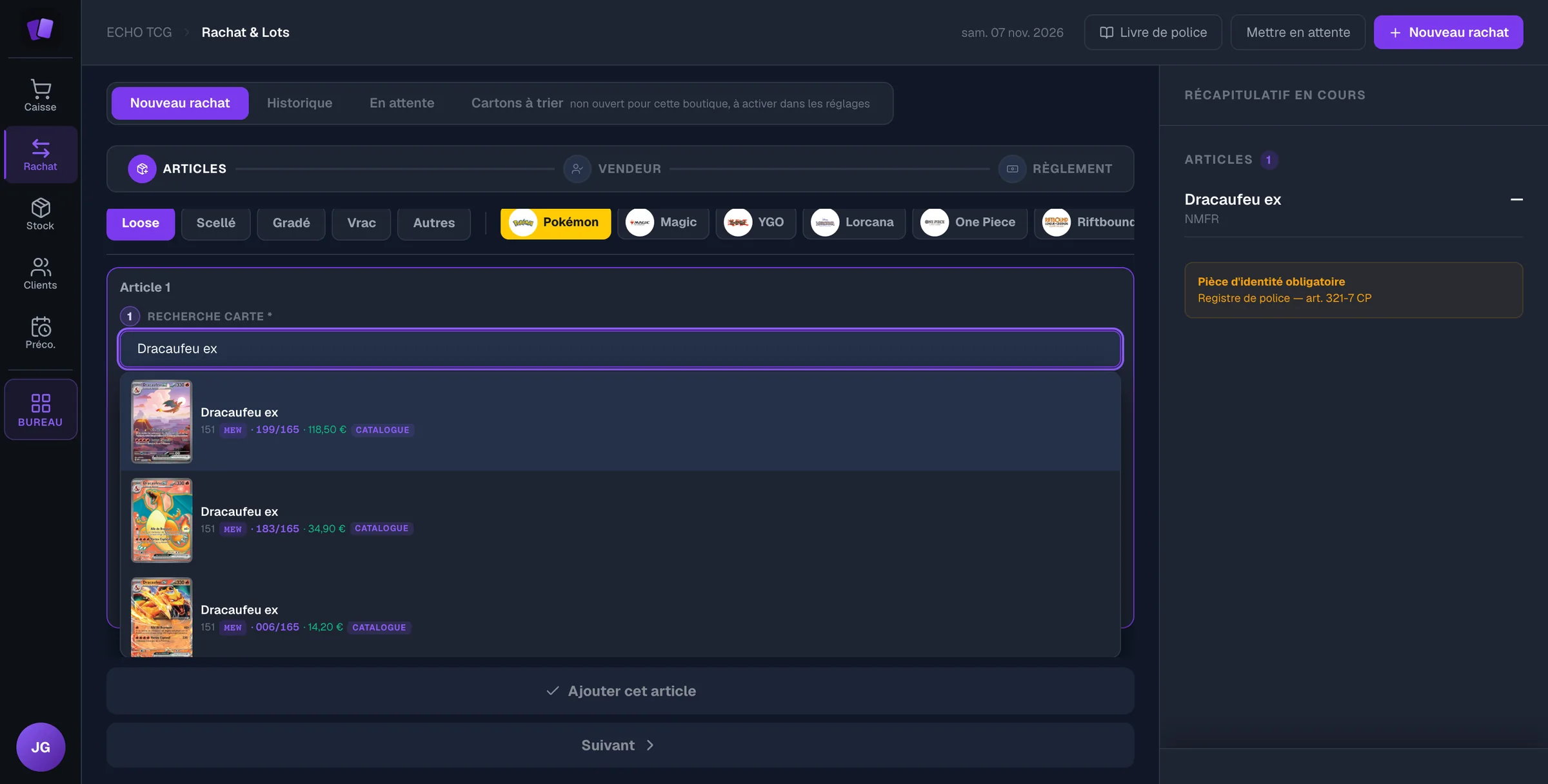
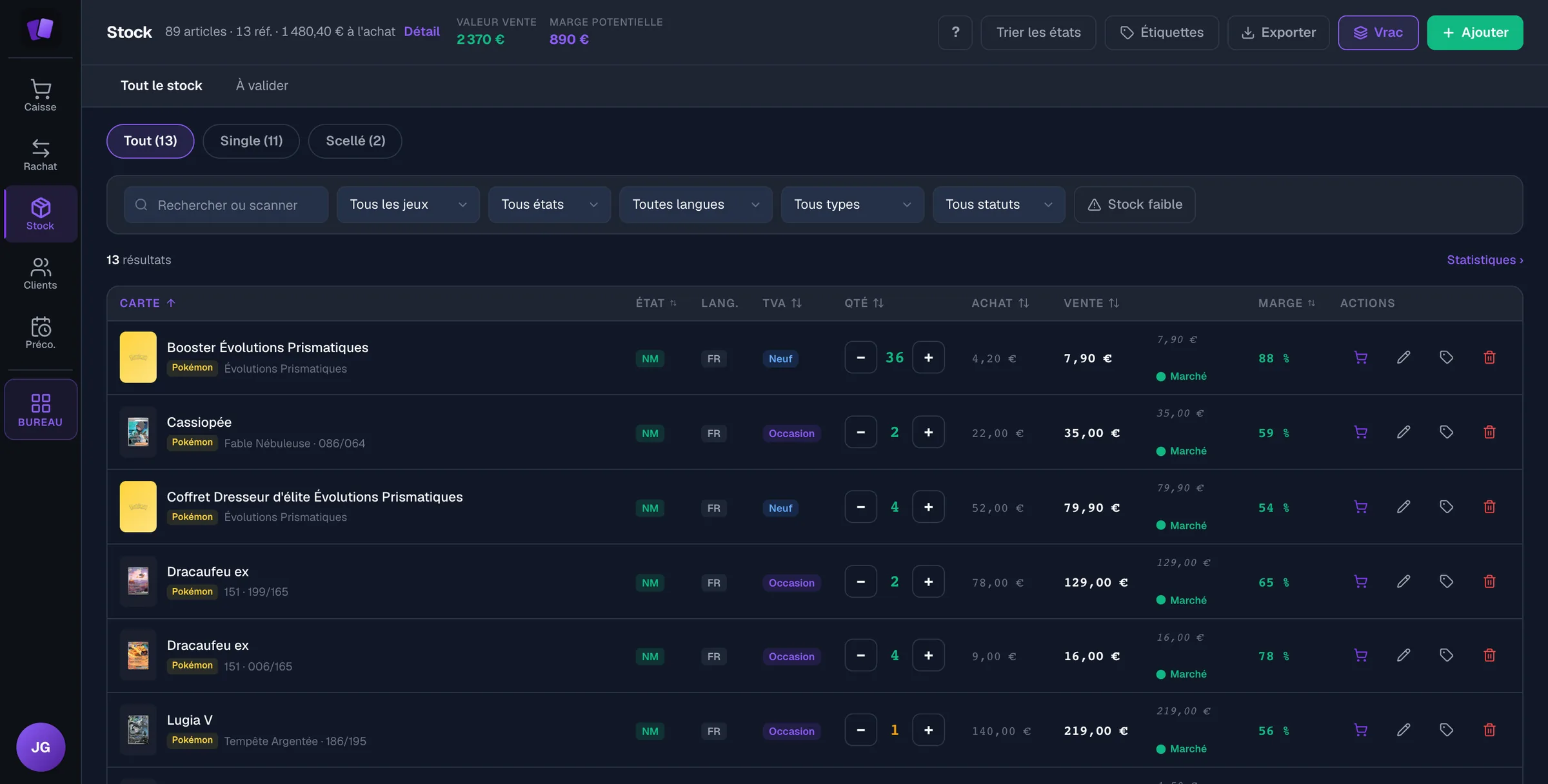
Record the reference consulted, review date, reason and person approving the decision. Link any change with replacing the affected displays. In Echo TCG, the price suggested during a buyback is a purchase price, never imposed; the software also supports printing price labels. Dormant-stock and low-margin alerts identify items to examine without deciding their selling prices. Keep commercial judgement separate from information drawing your attention to an item, so colleagues understand why a reference is being reviewed and what remains to be checked before the decision is complete.
What should labels make clear to customers and staff?
Labels should let customers and staff connect a price with the correct product without ambiguity. Provide a readable name, a recognisable reference and the characteristics needed to avoid confusion. For singles, condition and language may be decisive; for graded cards, the grade and company distinguish the copy. Place the label on a suitable support without covering useful information or risking damage to the card, sleeve or holder when it is handled.
After printing, check the connection between label and item in actual selling conditions. Read it through the display glass, inside the binder and at the till. A correct label placed beside the wrong item is still an error. Remove old versions as you replace them and check labels remaining on reserve stock. The guide to till and labelling equipment helps prepare the devices, but the content and the associated product still need to be checked whenever a price changes or an item moves.
How should pricing decisions be shared with the team?
Share a written method explaining who prepares comparisons, who decides and who checks the displayed information. Give staff the details needed to answer questions about condition, differences between versions and revised prices. A short, precise explanation is more useful than an improvised justification. Identify who should receive an unresolved question when a comparable listing appears to contradict the shop’s decision, rather than leaving each colleague to invent a separate answer.
At staff handover, flag references under review and labels still awaiting replacement. If a customer identifies a discrepancy, establish the item and the affected displays before responding; a colleague’s memory is not supporting evidence. Keep recurring questions so descriptions and comparisons can be improved. Over time this creates a pricing approach grounded in the products you actually offer, with decisions staff can retrieve and explain. It also makes corrections easier when the original identification or comparison turns out to have been incomplete.
Frequently asked questions
- Should you automatically copy the Cardmarket market value?
- No. Use it as a reference alongside successful eBay sales and the characteristics of your copy. Check condition, language, edition and finish before accepting a comparison, then record the reasoning behind your decision.
- How should you price a graded card?
- Look for sales matching the edition, language, grading company and grade. Also examine the holder and the information identifying the copy. A sale of an ungraded card is not enough to establish the price of a graded example.
- When should selling prices be reviewed?
- Schedule regular reviews and revisit affected references when a reprint, shortage, change in sales or labelling error warrants attention. Record why the price changed and check every place where it appears.
- How can you avoid different prices in binders and display cases?
- Use a shared reference to identify the copy and a list of the places showing its price. After a change, replace old labels and check online listings as well as the price retrieved at the till.
Echo TCG: the POS and management software for card shops.
From €49 a month, with no commission on your sales. See pricing