What opening inventory does a card shop need?
Plan opening inventory for your card shop: sealed products, singles, accessories, cash reserves and stock turnover, guided by local players and customer demand.
By Paul Hilmarcher, founder of Echo TCG, working hand in hand with card shops.
Opening inventory for a card shop should follow the customers you intend to serve, the games played around your location and the cash you can actually commit. There is no universal split between sealed products, single cards and accessories. A useful method gives every purchase a purpose, considers how it will be replenished and preserves room for the requests you will discover after opening. Start with evidence you can collect locally, then make decisions you can revise without putting the next supplier payment at risk.
Which customers should guide the opening selection?
Start with the people whose needs your shop will meet. A family learning a game may need advice and something ready to play; a regular player may be searching for a particular card; a collector may care most about edition, language and condition. These customers can share a shop without needing identical shelves. Write down the requests you intend to fulfil immediately and those you will handle through a special order.
Speak with local associations, observe public gaming events and record questions in local community groups. Ask what people have actually bought and what they struggle to find nearby. An expression of interest is not an order. Keep the date and context of your observations so that enthusiasm among friends does not become an unsupported sales forecast. The guide to opening a card shop in France places this work within the broader preparation for opening.
How should you choose the games to carry?
Choose games for which you can explain local demand and maintain a useful supply. Record existing events, player profiles, requested languages and releases announced by the publisher. Then check the distributor’s actual conditions: account access, availability, order requirements, delivery charges and payment dates. A popular game that you cannot obtain reliably cannot play the same role as a range you can replenish.
Separate a continuing range from products you want to trial and items offered only on request. This gives each choice a clear role and avoids promising a complete range you cannot maintain. Also write down what would make you change the selection: repeated requests, a new local playing group or persistent supply difficulties. Your favourite game can inform your knowledge, but its presence in your own collection is not evidence of demand at this location.
How should sealed products, singles and accessories be divided?
Divide the purchasing budget by the purpose of each family rather than by an industry percentage. Sealed products support discovery and new releases; singles meet specific searches; accessories help customers protect, carry and use their cards. For each family, enter your proposed spending, target customers, replenishment lead time and the observations behind your choices. Keep uncertain demand visibly separate from confirmed requests.
Add the commitments together and compare them with the money left after other opening expenses. If the selection does not fit, reduce the least supported purchases first. Do not automatically distribute the remainder equally: a coherent smaller range can answer customers better than scattered stock. Your card shop business plan connects these decisions with premises, operating expenses and sales assumptions, making the trade-offs easier to explain.
Which sealed products belong in the opening order?
Choose sealed products whose purpose and intended customer you can explain. Distinguish introductory products, booster packs, collector boxes and products needed for events you intend to organise. Check language, stated contents, supplier packaging and storage requirements. A product that looks attractive in a catalogue may be awkward to display or keep safely in your available space. Consider that practical constraint before committing to the order.
Compare the proposed quantity with replenishment time and the strength of the demand you observed. Ask what the supplier has confirmed and what remains provisional. Avoid committing all available purchasing money to an anticipated release: delivery can move and local preferences can change. Establish reservation rules before making customer commitments. The guide to pre-orders and new releases helps connect those promises with the quantities you can actually obtain.
How can buybacks supply the singles range?
Build the singles range around customer searches and an explicit purchasing method. Collections offered by private sellers can supply it, but a collection is more than its most noticeable cards. Review language, version, condition, duplicates and the work required to identify and organise everything. A purchase you cannot process promptly remains cash tied up in goods that customers cannot yet find or buy.
Define which cards you seek, which you decline and how you explain an offer. The guide to setting card buyback prices distinguishes purchase cost, intended resale price and the risk of holding inventory. Prepare the applicable formalities and records before starting. Your choice of legal structure for a card shop belongs in the discussion with a professional adviser; it does not replace a practical purchasing process or the documentation needed for each acquisition.
Which accessories should you include?
Include accessories that match the cards and uses you actually offer. Sleeves, binders, storage boxes and play mats should follow card sizes, required capacity and player habits. Ask suppliers for the specifications that establish compatibility. A visually appealing accessory still disappoints if it does not fit the cards the customer has just purchased. Being able to explain the difference is part of making the selection useful.
Begin with references you can describe clearly. Multiplying colours and models without identified demand creates more items to track and more space to manage. Plan their position near the products they support and make replenishment straightforward. The guide to laying out a card shop links the range with circulation and storage so that purchased stock can be displayed, found and handled without obstructing everyday activity.
How much cash should remain available?
Set your reserve from payment dates, future orders and the buyback opportunities you want to keep open. Separate committed money, purchases you can postpone and cash needed for ordinary expenses. The current account balance alone does not describe what is available: an outstanding invoice or confirmed supplier order may already have a claim on part of that balance. Use your own payment schedule to make the distinction explicit.
Place supplier payments, your rent, other expenses and planned releases on the same calendar. Add a buyback allowance that you can revise using sales actually received. Customer deposits belong to orders you must fulfil; do not treat them as unrestricted funding for an unrelated range. Also consider a delayed delivery or a slower opening period, then identify which purchases you would suspend. This turns a reserve into a practical decision rule rather than an unexplained amount.
How can you monitor turnover from the first month?
Track receipts, sales and remaining quantities by product and family from the first month. A spreadsheet is enough to start: the guide on stock management with a spreadsheet gives the columns to create and says where it reaches its limits. Record receipt dates, documented acquisition costs, outgoing quantities and unfulfilled requests. Compare periods of equal length and distinguish products available throughout the period from recent arrivals. Otherwise a late delivery may look like weak demand even though customers had little opportunity to purchase the product.
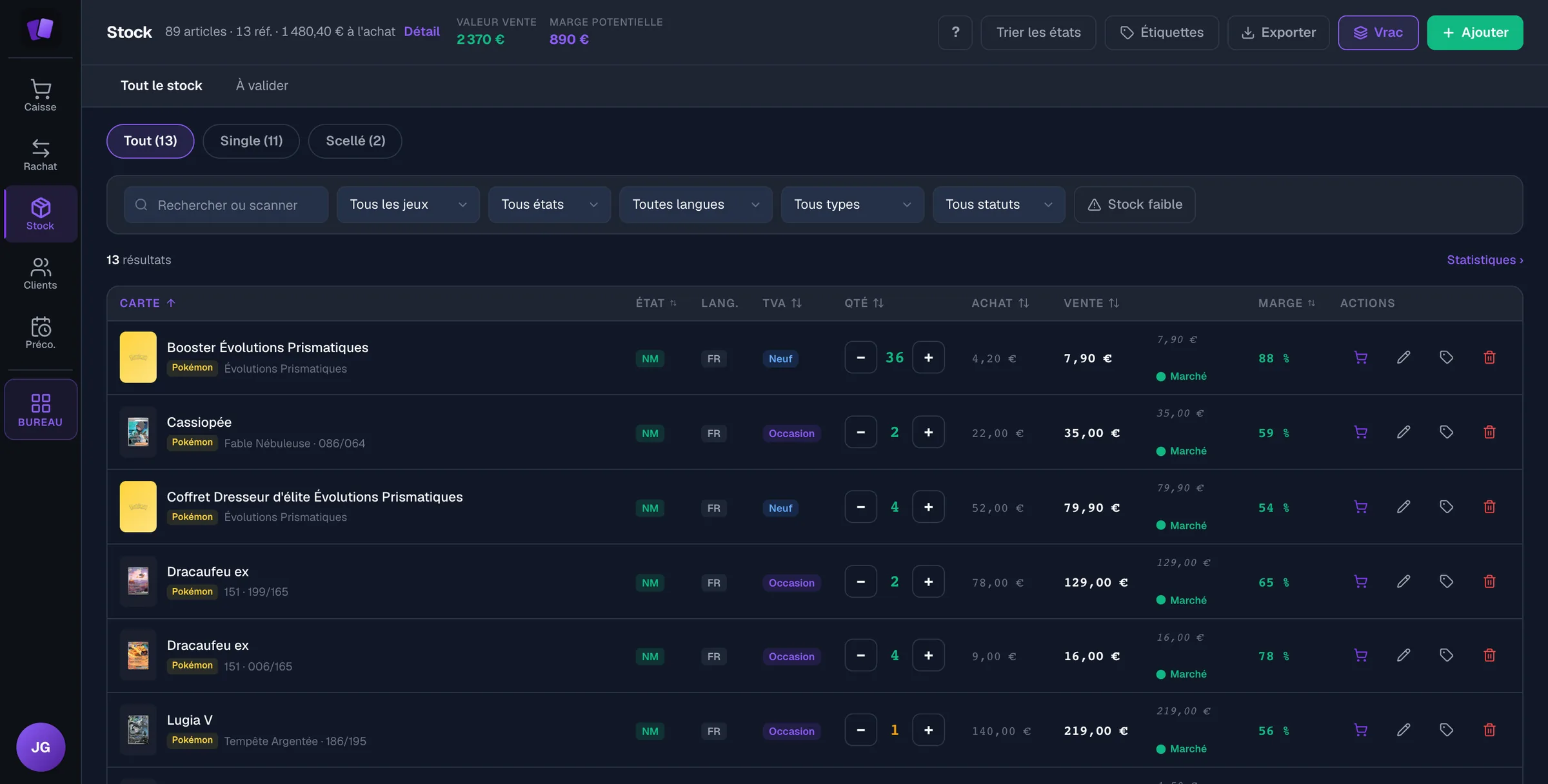
For inventory turnover, compare the cost of goods sold with average inventory valued at purchase cost over the same period. Keep valuation consistent and clarify its application with your accountant. Read quantities and age alongside that measure: an overall result can hide popular singles that have sold out and boxes that remain untouched. Echo TCG brings sealed products, singles and accessories into one inventory and includes dormant-stock alerts; deciding what to reorder remains the shopkeeper’s responsibility.
When should a product be replenished or reduced?
Replenish when observed sales and continuing demand justify another purchase that fits your payment schedule. An isolated stockout is not enough: determine whether it reflects continuing interest, a particular release or an exceptional order. Record requests lost because the product was unavailable. Equally, before deciding an unsold product is unwanted, check whether customers could see it, understand it and find the language they wanted.
Then choose whether to keep it, present it differently, stop reordering it or adjust the range. Record the reason and a review date. Avoid buying another slow reference merely because it accompanies an attractive supplier order. The aim is to free space and cash for observed needs while preserving a range that returning customers can understand. The opening selection should become more informed as trading produces evidence.
Which mistakes should you catch before ordering?
Catch purchases without an intended customer, exhausted cash reserves and missing inventory records before approving the order. Building your ideal personal collection, assuming all languages sell alike or treating online attention as local purchasing demand weakens the plan. Opening sealed products in the hope of finding sought-after cards is also uncertain; expected pulls do not replace a documented supply method.
Review each order line by asking who will buy it, what supports that belief, where it will be stored and how you will decide whether to replenish it. Mark the unknowns clearly. Opening inventory is a working assumption, not a final answer. Its quality depends on whether early sales can improve it while the shop continues meeting payment dates and remains able to consider a relevant collection offered for purchase.
Frequently asked questions
- Should a new shop carry every game?
- No. Start with games supported by documented local demand and accessible supply. Keep others on request or in a selection you will review.
- How should the budget be divided between sealed products and singles?
- Allocate spending by customer needs, replenishment times and available cash. No fixed split suits every shop.
- Can buybacks supply opening inventory?
- Yes, when the cards fit your customers and you have prepared assessment, applicable formalities, storage and the cash needed to purchase them.
- When should the first selection be reviewed?
- From the first month, compare sales, unfulfilled requests and remaining references. Consider receipt dates before deciding what to reorder.
Echo TCG: the POS and management software for card shops.
From €49 a month, with no commission on your sales. See pricing