Opening distributor accounts when you launch your shop
How to become a retailer of Pokémon, Magic and One Piece cards: opening distributor accounts, documents to supply, terms to compare and pitfalls to avoid.
By Paul Hilmarcher, founder of Echo TCG, working hand in hand with card shops.
When you prepare your opening stock, one question comes up fast: where do you buy sealed products at a trade price, and how do you become an “official retailer” of Pokémon, Magic or One Piece? The answer is less formal than you might think, but it takes method. This article describes opening accounts with distributors, the documents you will be asked for, what to compare and the pitfalls of sourcing. It deliberately gives no margin or discount figures: they vary by distributor and by period, and only a written quote counts.
Official retailer: what the term covers
No text defines this status; the term refers to an agreement with the publisher or its distributor. Do not display it without that written agreement. In practice it describes a shop that buys new products through the channel the publisher intends, most often a distributor or wholesaler, rather than from individuals or retail chains. That channel is what guarantees where the products come from and when they are available.
Three things are often confused. Access to products: a trade account with a distributor. Access to organised play: a tournament-organiser programme offered by the publisher. Visibility: some publishers list on their website the shops that take part in their programmes. The last two are steps specific to each publisher; the first is commercial and is negotiated with the distributor.
Opening an account with a distributor
A distributor sells to professionals, so it will ask you to establish that you are one. Depending on the distributor, the most common requests are:
- proof of the business's registration (an extract from the trade register or an equivalent document depending on your status);
- your intra-community VAT number, if you have one;
- the shop's address and the delivery address;
- bank details, sometimes a request for payment terms;
- sometimes a description of the business, photos of the shop floor or a website address.
Gather these documents in one folder before contacting anyone: you will be asked for them by every distributor, then again whenever your situation changes. If the shop is not open yet, ask each distributor what it accepts at this stage (company created, lease signed): the answer varies from one distributor to the next.
What to compare before choosing
Two distributors can offer the same product on very different terms. Compare in writing, on the same selection of products:
- the purchase price excluding tax and any discounts by quantity;
- the minimum order, shipping costs and the free-shipping threshold if there is one;
- the delivery time and the cut-off dates to reserve a release;
- the payment method and terms;
- what happens when a product is missing, damaged or late;
- how highly demanded releases are shared out between shops.
That last point deserves a direct question. For highly anticipated releases, quantities are sometimes limited and shared among the distributor's customers: ask how it proceeds and from what moment an order is firm. Do not build your first month's cash flow on an allocation nobody has confirmed to you.
Pokémon, Magic, One Piece: three games, three channels
Each publisher organises its distribution in its own way, and these arrangements change. The most reliable approach is to start from the publisher's official website, then contact directly the distributors and programmes it points to.
- Pokémon: the publisher presents on its website the Play! Pokémon organised-play programme, for shops that host tournaments. Products are bought from distributors, which you identify through the publisher or its representatives.
- Magic: the publisher runs the Wizards Play Network, which brings together the shops that organise events. Products are bought from distributors; the conditions for joining the network are published on its website.
- One Piece Card Game: check the game's official website to find out whether a programme for shops exists and how to join it, then order products from a distributor.
The approach is the same for Yu-Gi-Oh!, Lorcana or any other game you want to add: official website, distributor, then organiser programme if you plan to host tournaments. Choosing games is prepared beforehand, with the guide on choosing which games to carry.
The pitfalls of sourcing
- Topping up an allocation by buying from supermarkets, online or from unidentified resellers: the margin disappears and the origin is no longer guaranteed.
- Trusting a price that is too low to be true: counterfeit products exist, especially on highly sought-after items. Check the packaging and demand an invoice in the seller's name.
- Committing all your cash to a single release: its arrival can slip, and local demand can change.
- Confusing new and second-hand: a sealed product bought from a distributor is not a second-hand good.
A product bought new from a distributor is resold with VAT at the standard rate on the selling price. A shop subject to VAT deducts the VAT on its purchases; under the VAT exemption (franchise en base), it charges no VAT and cannot deduct the VAT on its purchases. The margin scheme concerns second-hand goods acquired with no recoverable VAT: from an individual, or from a professional who sold under the margin scheme themselves. A second-hand card bought from a professional with VAT stays under the standard scheme. See the article on margin VAT. The tax diagnostic gives a first orientation before opening.
Tracking orders and stock from the first box
A distributor account quickly produces a lot of paper: purchase orders, delivery notes, invoices, credit notes. For each order, keep the date, the reference, the quantity ordered, the quantity received and the purchase price: that is what lets you calculate the real margin and spot a delay.
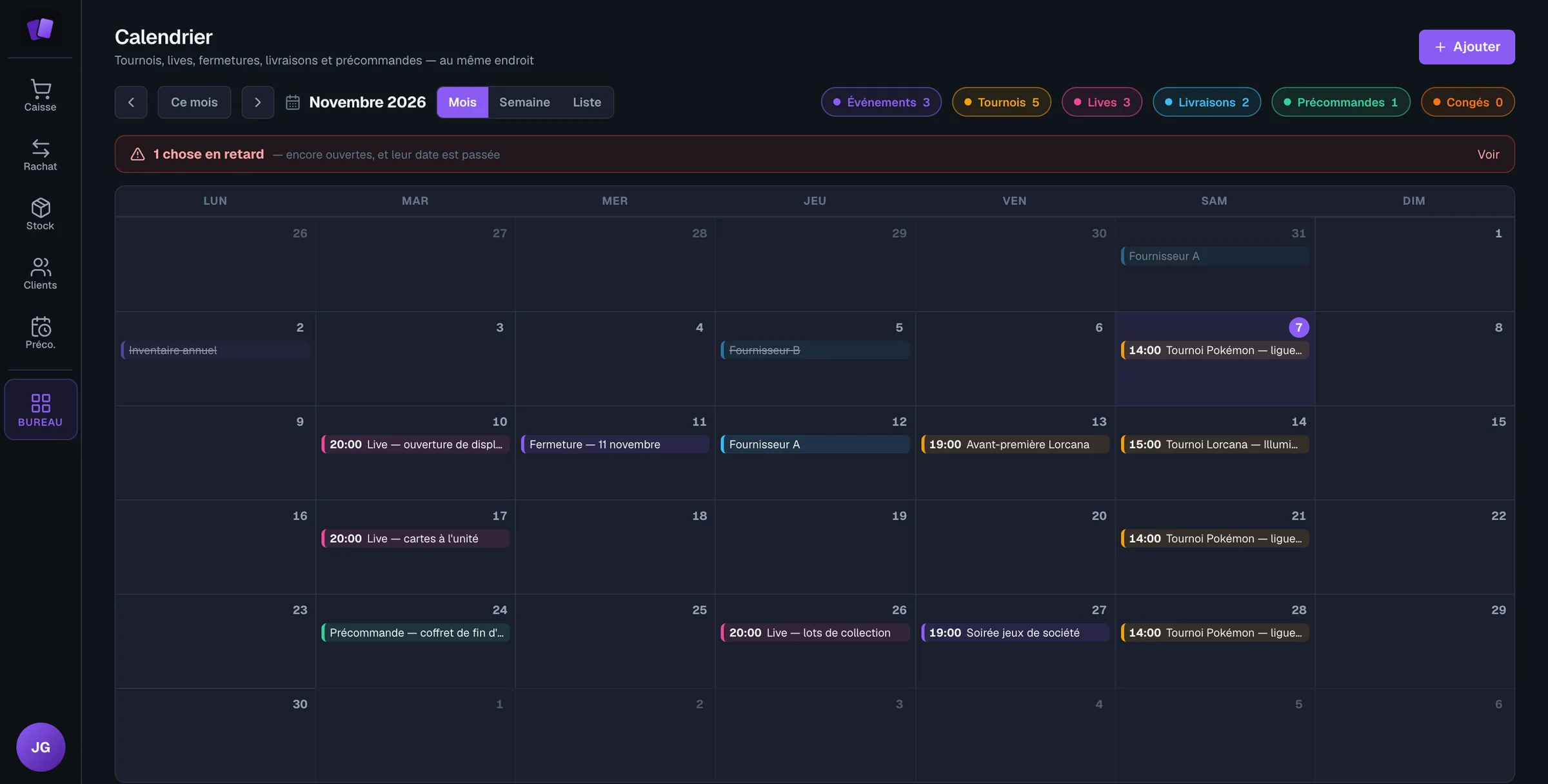
In Echo TCG, supplier orders (Pro plan) track the state of each order (ordered, received, late) and allocate quantities on arrival; stock accepts sealed products, single cards, graded cards and accessories. Echo TCG does not place orders for you and gives you no access to any distributor: it tracks your purchases and your stock once your accounts are open. Features and plans are detailed on the features page.
A timeline for opening your accounts
- Before signing the lease: choose the games and list the distributors to contact.
- As soon as the company exists: gather the documents and send the first requests, because opening an account can take time.
- Before opening day: place a first modest order and check the real delivery and invoicing times.
- After opening: track the gaps between ordered, received and sold, and review your choice of distributors after a few months.
The guide to opening a card shop in France gives the full order of steps, and the article on the opening stock explains how to size those first orders. Customer reservations are covered in pre-orders and releases, and tournaments in the guide to running official tournaments.
This article is informational and does not replace your accountant's advice or each distributor's written terms.
- Pokémon, official website (Play! Pokémon programme for shops)
- Wizards Play Network: the network of Magic event-organising shops
- One Piece Card Game, official website
- Service-public.fr Entreprendre (in French): business creation and registration procedures
- BOFiP, BOI-TVA-SECT-90 (in French): second-hand goods, taxation principles
Frequently asked questions
- Do you need a special status to be an official card retailer?
- No text defines this status; the term refers to an agreement with the publisher or its distributor. Do not display it without that written agreement. You need a registered business, then a trade account with one or more distributors, each setting its own terms.
- Can you open a distributor account before the shop opens?
- It depends on each distributor. Ask what it accepts at this stage (company created, lease signed, documented project) rather than assuming, and prepare the same documents as for an open shop.
- What is the difference between a distributor account and a tournament programme?
- The distributor account gives access to products at a trade price. The organiser programme, offered by each publisher, concerns official tournaments. They are two independent steps with different conditions.
- Can you buy stock somewhere other than from a distributor?
- It is possible, but the origin and authenticity of the products are less certain and the margin can disappear. For new products, favour the channel the publisher intends; for second-hand cards, buying from individuals follows its own rules (police register, margin VAT).
- Does Echo TCG open accounts with distributors?
- No. Echo TCG does not place orders for you and gives no access to any distributor. It tracks your supplier orders (Pro plan) and your stock once your accounts are open.
Echo TCG: the POS and management software for card shops.
From €49 a month, with no commission on your sales. See pricing