Graded cards in your shop: buying, reselling and VAT
Graded cards in a shop: checking a slab before buying, keeping the police register, applying margin VAT and tracking your inventory, from purchase to resale.
By Paul Hilmarcher, founder of Echo TCG, working hand in hand with card shops.

A graded card is a card placed by a specialist company in a sealed slab, with a grade that assesses its condition and a certificate number. For a shop, it differs from an ordinary card on almost every front: it is bought after particular checks, its price depends on the grade more than on the card itself, its description in the police register is more precise, and its tax treatment raises questions this article states honestly. It follows the journey of a graded card, from purchase to sale.
What a graded card is, and what makes it different
The grading companies best known to shops are PSA, BGS, CGC, PCA, CCC and ACE. Each has its own grade scale, its own slab and its own numbering system. Two cards that look identical can be worth very different sums depending on the company and the grade: you value the copy, not just the card. That is also why a missing certificate number in your stock is a serious flaw: it prevents you from checking the item and finding it again.
Buying: the checks before you pay
A seller offering a graded card asks you to trust them on an object you cannot open. So get into the habit of a fixed sequence, the same for every purchase:
- compare the label and the card: name, set, number and language must match;
- check the certificate number on the grading company's website when it offers that check;
- examine the slab: intact seal, no cracks or signs of opening, a finish consistent with that company's;
- judge the visible condition of the card, which must stay consistent with the stated grade;
- refuse, or do not pay, at the slightest doubt: tampered slabs exist.
An unscrupulous seller counts on haste: the time spent checking is also a reason not to pay faster than necessary.
Setting the price of a slabbed card
A graded card's price is based on completed sales of the same card, from the same company, with the same grade. The raw card's price is not a reference: the same card changes value depending on the grade it received. Start from sales actually completed rather than listings, adjust for local demand and turnover time, then explain your reasoning to the seller. The general method is that of the article on buy-back pricing; only the basis of comparison changes.
The police register for a graded card
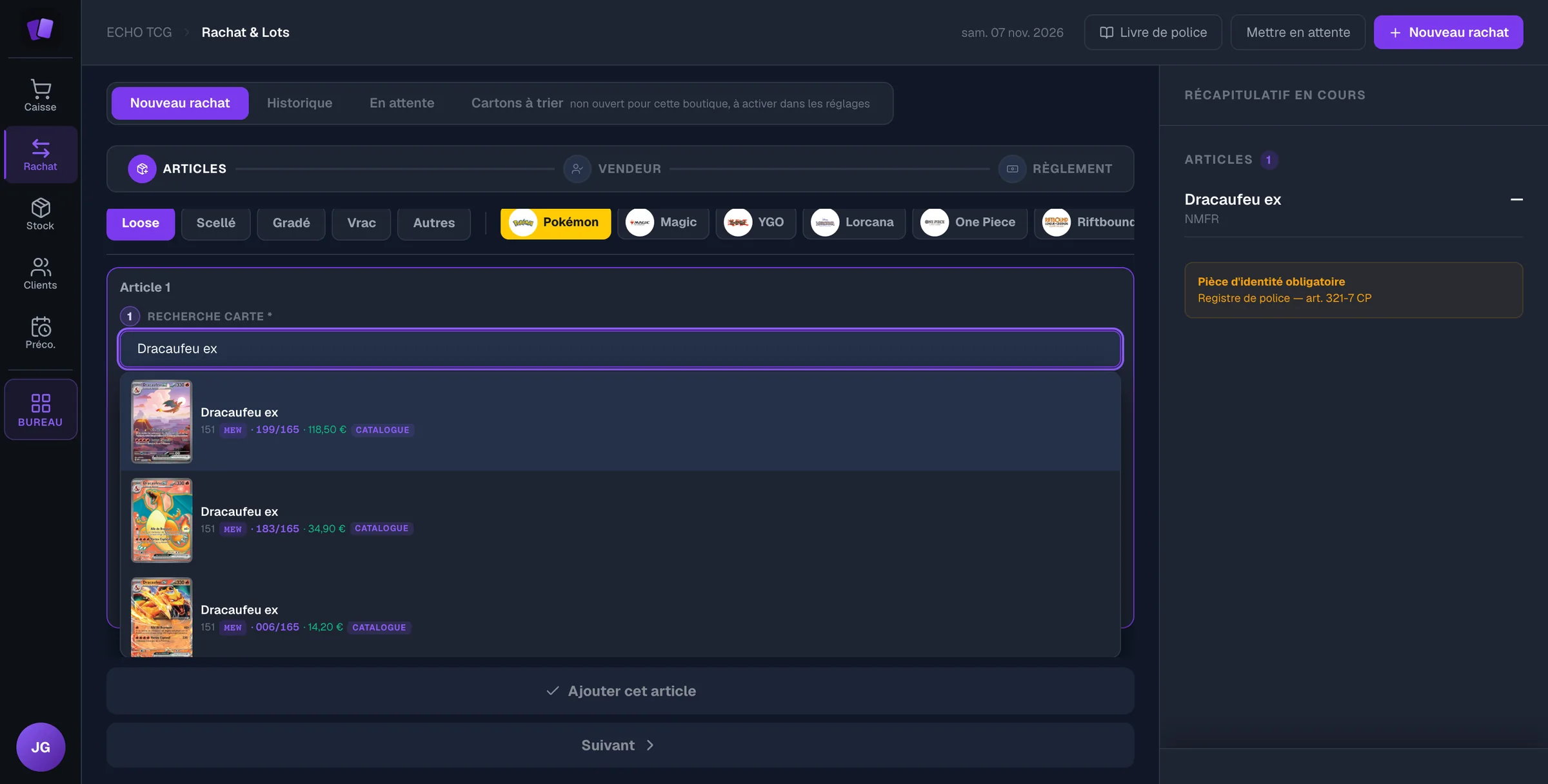
Buying back a graded card from an individual falls under the police register of movable goods (article 321-7 of the French Penal Code). The description must let you find the item without hesitation: the game, the name, the set, the printed number, the language, the grading company, the grade and the slab's serial number. With the seller's identity and the price paid, it establishes who sold the card; on its own it does not prove the absence of deductible VAT. The guide on the police register details the entries.
VAT: the origin of the item decides
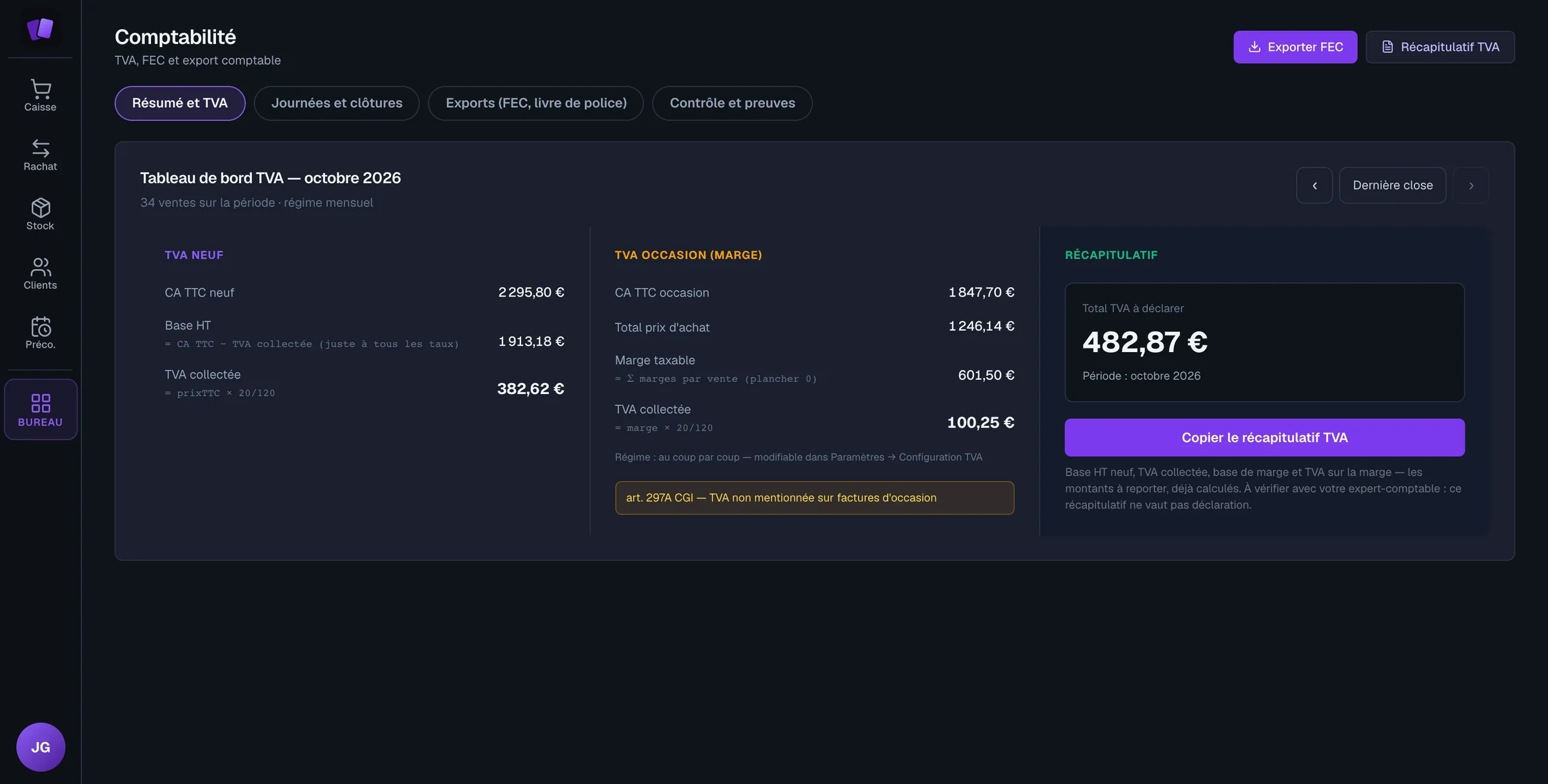
The scheme does not depend on the type of card, but on where the item came from and who sold it. A graded card bought back from an individual is a second-hand good, unless the scale or repetition of the supplies makes the seller a professional in fact (ruling BOI-RES-TVA-000270): its resale falls under the margin scheme (article 297 A of the French tax code), meaning VAT applies to the difference between the selling price and the purchase price of that copy. Sales under this scheme do not show VAT on the invoice, which carries the wording “Régime particulier – Biens d'occasion”.
A fictional example, for the calculation only: a graded card bought back for €200 and resold for €260 leaves a €60 margin. The VAT due on that sale is 60 × 20 / 120 = €10, against 260 × 20 / 120 = €43.33 if it had been calculated on the selling price. The detail of the calculation and the options (transaction by transaction or global method) is in the article on margin VAT.
The questions your accountant must settle
Three situations often arise in a shop and cannot be settled in one sentence. They deserve a written answer from your accountant, then applied consistently:
- Grading costs. A raw card bought back, sent for grading by the shop, then resold in a slab: do these costs reduce the margin, add to the purchase price, or stay a separate expense? Do not add them to the purchase price without their agreement.
- Buying from a professional. The seller's invoice states the treatment they applied; it determines what you can do on resale and what you can deduct. Keep it.
- A grading service for a customer. The card stays theirs and you invoice a service: its VAT treatment is that of a service, to be confirmed with your accountant.
Tracking a graded card's inventory
A graded card deserves its own record, with the grading company, the grade, the certificate number, the purchase price and the buy-back date. Store it safely: slabs scratch, and a display case exposed to passers-by is a theft risk, which the guide on preventing theft in a shop and the one on insurance invite you to anticipate for valuable pieces.
In Echo TCG, stock accepts graded cards as a format in its own right. The graded card inventory (Pro plan) lists first the cards without a certificate number. Grading for your customers (Pro plan) tracks cards a customer leaves with you to be graded: intake, sending by batch, tracking until they come back, the card remaining theirs. Selling a graded card stays open to every plan. The full list is on the features page.
Reselling and what you commit to
Describe the card with the same precision at sale as at purchase: company, grade, certificate number. A consumer buyer benefits from the legal guarantees of sale, second-hand goods included; a faithful description spares you disputes. To know when an invoice is needed rather than a receipt, see the article on invoice or receipt in a shop.
This article is informational and does not replace your accountant's or a lawyer's advice.
- Article 297 A of the French Tax Code (Légifrance, in French): the margin scheme and its tax base
- Articles 297 A to 297 G of the French Tax Code (Légifrance, in French): the whole scheme, including the ban on showing VAT (art. 297 E)
- BOFiP ruling of 19 August 2026 (in French): an unused item can be a second-hand good
- BOFiP, BOI-TVA-SECT-90 (in French): second-hand goods, taxation principles
- French Penal Code (Légifrance, in French): article 321-7 and articles R321-1 to R321-8, the register of second-hand movable goods
- Article 242 nonies A, Annex II of the French Tax Code (Légifrance, in French): the “Régime particulier – Biens d'occasion” mention
Frequently asked questions
- Does a graded card bought back from an individual fall under margin VAT?
- In principle yes: it is a second-hand good acquired from someone who could not deduct VAT. VAT is then calculated on the difference between the selling price and the purchase price of that copy. Your accountant confirms how it applies to your shop.
- What should go in the police register for a graded card?
- The seller's identity, the price paid and a description that lets you find the item again: the game, the name, the set, the number, the language, the grading company, the grade and the slab's serial number when there is one.
- How do you check that a slab is genuine?
- Check the certificate number on the grading company's website when it offers that check, compare the card with the label, and examine the slab (seal, cracks, finish). Tampered slabs exist: if in doubt, do not pay.
- Can grading costs be deducted from the margin?
- The question arises, and the answer depends on the applicable text and your situation: do not add them to the purchase price without your accountant's agreement.
- Does Echo TCG handle graded cards?
- Yes. Selling a graded card is open to every plan. The graded card inventory (PSA, BGS, CGC, PCA, CCC, ACE), where cards missing a certificate number are listed first, and grading for your customers are on the Pro plan.
Echo TCG: the POS and management software for card shops.
From €49 a month, with no commission on your sales. See pricing