DAC7: what platforms tell the tax office about sellers
DAC7 in France: what selling platforms report to the tax office, the 30 sales and €2,000 thresholds, and what it changes for a card shop or a collector.
By Paul Hilmarcher, founder of Echo TCG, working hand in hand with card shops.

A card shop that sells part of its stock online, or a player selling off a collection, often goes through a platform: Vinted, eBay, Cardmarket, Whatnot. Since transactions carried out in 2023, these intermediaries have a reporting duty towards the French tax authorities, stemming from a European directive known as DAC7. Here is what it provides, and what it does not.
What DAC7 provides
The scheme sits in articles 1649 ter A to 1649 ter E of the French tax code, introduced by the 2022 Finance Act. It targets platform operators that electronically connect sellers and buyers. It applies to transactions carried out since 1 January 2023 and replaces the former scheme of article 242 bis. The underlying European directive organises the exchange of this information between Member States' tax authorities.
The platform files its data by 31 January of the year following the transactions at the latest. By the same deadline, it gives each seller concerned a summary of the information reported about them.
The thresholds: 30 sales or €2,000
For sales of goods, a seller is not reported if, over the whole year, they made fewer than 30 sales on the platform for a total of no more than €2,000. Both conditions must be met. In other words, the 30th sale of the year is enough to be reported, even for small amounts, and so is a single €2,100 lot.
What is reported
According to the specifications published by the tax authorities, the report includes in particular:
- the seller's identity: for a person, surname, first name, address, date of birth and tax number; for a business, company name, address, tax number and VAT number if it has one;
- the identifier of the account the money is paid into;
- the number of transactions and the total amount received, per quarter.
The tax authorities may cross-check them against your returns.
Reported does not mean taxable
The tax authorities point this out themselves: the DAC7 thresholds trigger no tax. The scheme changes nothing in existing taxation. It only makes the sales visible. Two situations must be told apart.
- Selling your own belongings, which you are parting with and did not buy to resell: in principle these sales are neither declared nor taxed. Above €5,000 for a single sale, specific rules may apply, to be checked.
- Buying to resell on a habitual basis: this is a commercial activity, to be declared as such (registration, then income in the industrial and commercial profits category) and may give rise to social contributions.
A player who buys boxes to resell the singles, or who buys collections to sell them on online, may be in the second case, whether or not the platform reports them.
What it changes for a shop
For a registered shop, nothing changes in what it must declare: its online sales are already part of its turnover. The difference is that the tax authorities now receive, from the platform, a statement of those same sales. From September 2027 they will also receive the shop's e-reporting data, and can cross-check the two. Three habits follow:
- enter the business identity on each platform (company name, tax number, VAT number) rather than a personal account;
- each year, reconcile the summary received in January with the online turnover recorded in the accounts;
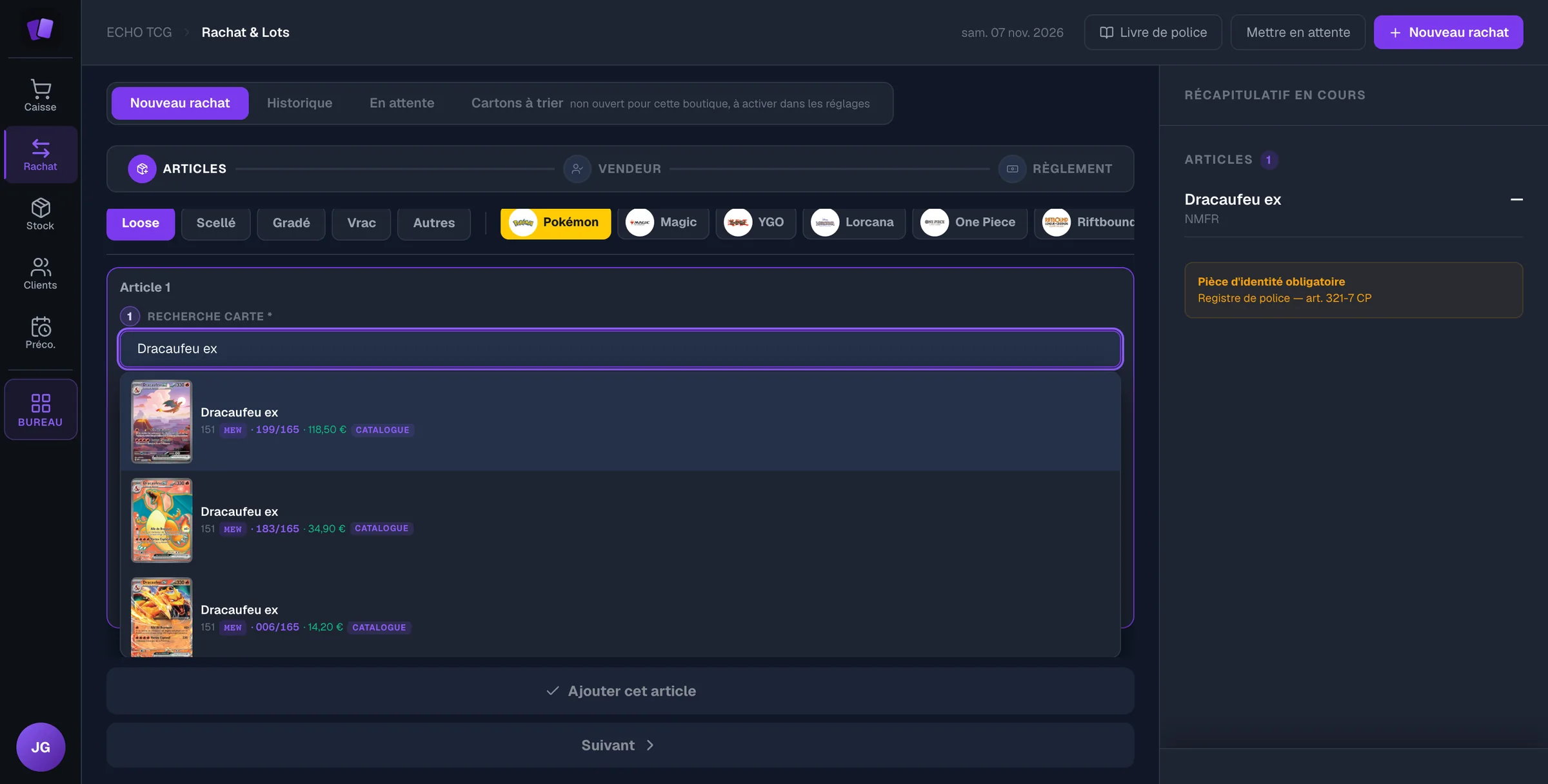
- keep cards bought from private individuals in the police register: selling online does not exempt you from it.
Worked example
A fictional example, to illustrate the thresholds. Léa sells her personal collection on a platform: 24 sales in the year, for €2,350 in total. She makes fewer than 30 sales but exceeds €2,000: the platform reports her. That €2,350 comes from personal belongings she is parting with, and no sale exceeds €5,000: in principle, nothing is taxable. Her neighbour Hugo buys boosters at the supermarket, opens them and resells the cards: 40 sales for €900. He is reported because of the number of sales, and his sales may amount to a buy-to-resell activity, to be declared as such if it is habitual.
For a shop, Echo TCG keeps the police register for every card bought from a private individual; it does not replace an accountant.
Up to date as of 19/10/2026. General information, not personalised advice: the rules and thresholds quoted are those published by the French administration and read on 18 October 2026. For your own situation, ask a chartered accountant.
- Légifrance: French tax code, articles 1649 ter A to 1649 ter E (platform operators' reporting)
- impots.gouv.fr: income from collaborative platforms
- impots.gouv.fr: how do I declare income from the collaborative economy?
- impots.gouv.fr: transfer of information under the DPI-DAC7 schemes
- BOFiP: BOI-INT-AEA-30-30-30, duty to inform sellers
- economie.gouv.fr: selling personal belongings, must the income be declared?
Frequently asked questions
- After how many sales does a platform report me to the tax authorities?
- From 30 sales in the year on a single platform, or as soon as the total received on that platform exceeds €2,000. To avoid being reported you must stay under both thresholds at once: fewer than 30 sales and no more than €2,000.
- If I sell my card collection online, am I taxed?
- In principle no: selling personal belongings you are parting with is neither declared nor taxed, even if the platform reports the amounts. Specific rules exist above €5,000 per sale: check your own case.
- What does the seller receive from the platform?
- By 31 January of the following year at the latest, a summary of the information reported about them to the tax authorities. That is the document to compare with what you declare.
- Is a shop that sells on a platform concerned?
- Yes, its online sales are reported like any seller's. Nothing changes in what it must declare: those sales are already part of its turnover, and the amounts must match.
Echo TCG: the POS and management software for card shops.
From €49 a month, with no commission on your sales. See pricing