E-reporting in France: a card shop's sales to consumers
E-reporting in France: what a card shop will send about its sales to private customers from September 2027, how often, and what does not concern it at all.
By Paul Hilmarcher, founder of Echo TCG, working hand in hand with card shops.

France's e-invoicing reform has two parts. The first, electronic invoicing between businesses, is covered in our e-invoicing guide. The second directly concerns a card shop's till: e-reporting, i.e. sending the tax authorities the data of sales that do not give rise to an electronic invoice, starting with sales to private customers.
The timeline
- Since 1 September 2026: receiving electronic invoices is already in force for every business, and large and mid-sized companies issue electronic invoices and send their e-reporting data.
- From 1 September 2027: issuing electronic invoices and e-reporting apply in turn to SMEs and micro-enterprises (receiving is already mandatory).
The tax authorities state that joining the reform early for e-invoicing does not bring the e-reporting obligation forward. For a card shop, an SME or micro-enterprise in almost every case, the deadline is therefore September 2027.
The tax authorities will cross-check the shop's e-reporting data against the statements that selling platforms already send them about its online sales (DAC7): the amounts must match.
What is sent: daily totals
For sales to private customers, data is aggregated per day: the date, the day's amount excluding VAT and the corresponding VAT amount, broken down by VAT rate if there are several. No personal data is sent, not even the customer's name. The receipt handed to the customer remains a receipt.
Transmission can go through the approved platform chosen for electronic invoices. The tax authorities also mention the option of starting from a file produced by the till software, in which case the data is that of the daily summary, the Z report. For resale of second-hand cards under margin VAT, how to present those sales is a question for your accountant.
How often
The frequency follows the shop's VAT regime:
- monthly normal regime: every ten days (1st to 10th, 11th to 20th, 21st to month end), within ten days of each period;
- quarterly normal regime: every month, within ten days of the month end;
- VAT exemption (franchise en base): every two calendar months (January and February, March and April, etc.), between the 25th and the end of the following month.
Note: the simplified VAT regime is abolished on 1 January 2027. Shops currently under it move to the normal regime, monthly or quarterly depending on their situation; check with your accountant. They start e-reporting in September 2027 at the frequency of their regime.
What does not concern a sale of cards
E-reporting also has a payment data part. It covers transactions where VAT is due on collection, typically services, and not supplies of goods, except for deposits. A sale of a booster or a single card is therefore outside it. If the shop invoices services, such as tournament entry fees, check how they are classified with your accountant.
Worked example
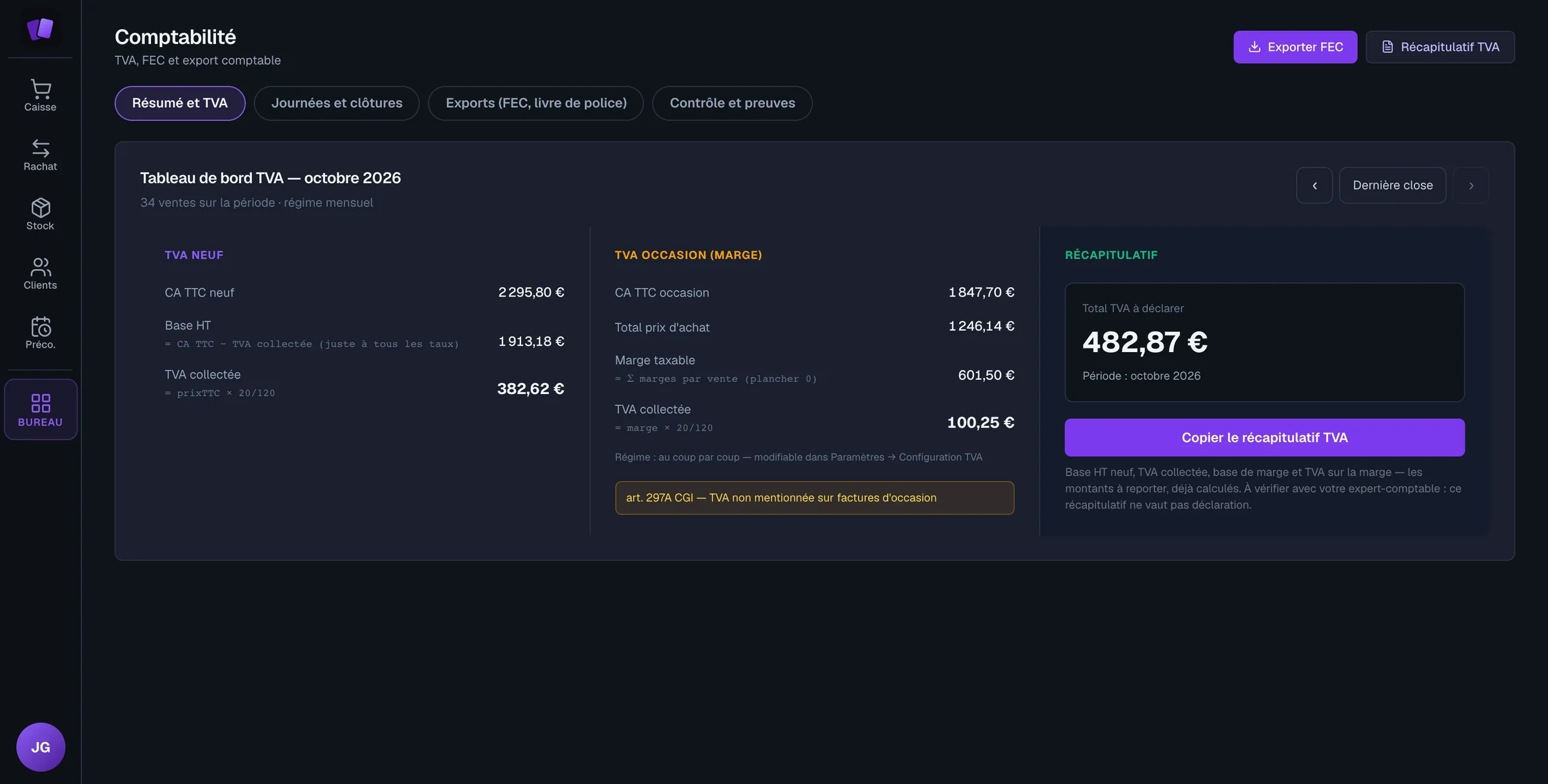
A fictional example, for a single day and a single rate. A shop under the monthly normal regime sells €720 including VAT of new products at 20% VAT. Amount excluding VAT: 720 ÷ 1.2 = €600. VAT: 720 − 600 = €120. The day's line sent therefore contains the date, €600 excluding VAT and €120 of VAT at the 20% rate, with no per-customer detail. If the day falls between the 1st and the 10th, it belongs to that ten-day period, sent by the 20th of the month at the latest.
Echo TCG produces the Z closing for each day; it does not currently send any data to an approved platform.
Up to date as of 19/10/2026. General information, not personalised advice: the rules and thresholds quoted are those published by the French administration and read on 18 October 2026. For your own situation, ask a chartered accountant.
- impots.gouv.fr: e-reporting, transaction data
- impots.gouv.fr: e-reporting, payment data
- BOFiP: BOI-TVA-DECLA-20-30-50-30, transmission of transaction data, procedures
- economie.gouv.fr: all about electronic invoicing for businesses
- impots.gouv.fr: the simplified VAT regime is abolished from 1 January 2027
- impots.gouv.fr: discovering electronic invoicing
Frequently asked questions
- When must a card shop start e-reporting?
- On 1 September 2027 for SMEs and micro-enterprises, which covers most shops. Large and mid-sized companies have been subject to it since 1 September 2026.
- Do customer names have to be sent?
- No. E-reporting of sales to private customers sends daily totals: the amount excluding VAT and the VAT amount, per rate. No personal data is sent.
- How often must sales data be sent?
- Every ten days under the monthly normal VAT regime, monthly under the quarterly normal regime, and every two calendar months under the VAT exemption. The simplified VAT regime is abolished on 1 January 2027.
- Are paid tournaments part of payment e-reporting?
- Payment data covers transactions where VAT is due on collection, typically services. A sale of cards, a supply of goods, is not concerned, except for deposits. For tournament entry fees, check how they are classified with your accountant.
Echo TCG: the POS and management software for card shops.
From €49 a month, with no commission on your sales. See pricing