Card shop glossary: the terms of the trade
Card shop terms explained: games, products, condition, buybacks, till records, French tax and daily organisation. A glossary to help teams share clear meanings.
By Paul Hilmarcher, founder of Echo TCG, working hand in hand with card shops.

Card shop vocabulary describes products, their condition, transactions and the organisation of a retail business. This glossary brings together terms used when talking to suppliers, helping collectors or preparing work for the team. The meaning of a word on packaging never replaces checking the exact product reference, and apparently similar descriptions can refer to different physical items.
The tax definitions and the police register refer to the French context. They are reading aids rather than a way to determine the treatment of an individual transaction. If you are choosing management software, the till selection checklist turns these concepts into questions for the publisher. Keep the French document names when working with a French accountant so that both parties can identify the same records.
Which terms describe games and packaged products?
These terms identify game families and the product formats offered for sale. The exact contents of a package depend on its game, set and edition, so they should be checked against the supplier’s product reference.
- TCG: abbreviation for trading card game, in which collectible cards can be used to play under shared rules. Collecting and playing may create different purchasing needs within the same product range, even for the same customer.
- JCC: French abbreviation for jeu de cartes à collectionner, meaning collectible card game. It describes a family of games rather than the contents of a particular package or the rules of a specific tournament format.
- Booster: a sealed pack of cards whose composition follows the rules announced for that product. Card counts and possible contents vary across ranges, and a pack does not guarantee a particular sought-after card unless expressly specified.
- Display: a box containing several booster packs, often designed to present them for retail sale. Check the contents of the specific reference, because the term does not represent one universal number of packs across games and products.
- ETB: abbreviation for Elite Trainer Box, a Pokémon product known in French as a Coffret Dresseur d’élite. Its assortment of cards and accessories depends on the edition, so the listed contents of that particular box matter.
- Deck: a collection of cards prepared for playing a game under the rules of a particular format. The term can describe a player’s own construction or a preconstructed product sold in its original packaging.
- Expansion: a release of cards within a game, generally identified by a name and code. Several different packaged products may distribute cards from that expansion without containing the same assortment or serving the same purpose.
- Series: a grouping used by a publisher, catalogue or shop to organise references. Its meaning may overlap with set or expansion, so check the classification in use when comparing catalogues or transferring product descriptions.
- Sealed product: a product whose closing packaging is still intact at the time it is described. This states something about its physical presentation, but does not by itself establish its acquisition history or tax treatment.
- Single: a card offered separately from a package containing multiple cards. Its version and relevant characteristics need to be identified, and selling it individually does not necessarily mean it is second-hand for tax purposes.
When a sealed product is opened to sell its contents separately, stock quantity and cost need to be tracked using the new selling unit. The guide to selling cards from opened packs develops that distinction and the questions it raises for a shop.
How do you describe a version and protect a copy?
A copy’s description combines its printing, finish and physical presentation. Cards with the same name may therefore need separate stock references, and protective packaging is not evidence of either condition or authenticity.
- Printed number: the identifier visible on a card, used alongside the game and set to find its reference. It does not always distinguish alternative illustrations, finishes or reprints that share the same printed number.
- Rarity: a classification assigned by the publisher to a card within a group of products. It is not a resale valuation and does not, on its own, describe actual buyer demand for that version.
- Foil: a card finish with a reflective or shiny treatment. The area covered and the technique vary by game and edition, and the presence of that finish should be distinguished from the card’s condition.
- Holo: a common term for a holographic finish, sometimes used in a way close to foil. Its exact meaning depends on the game and catalogue, so the visual appearance and specific variant need checking.
- Reverse holo: a variant whose reflective treatment covers different areas from the holographic version normally associated with the card. The exact treatment varies by edition and should be checked before copies are grouped together in stock.
- Alternative artwork: a version featuring an illustration different from the reference version being discussed. It may share a name or printed number with another printing without being interchangeable with it in a shop’s stock records.
- Promotional card: a card distributed through a particular product, event or promotional activity. That distribution context helps identify the version but does not by itself establish its actual scarcity, market demand or selling price.
- Graded card: a card assessed by an organisation using its own grading scale, generally enclosed in an identified holder. Read the grade together with the organisation’s name and the information attached to that particular copy.
- Sleeve: a flexible pocket intended to protect a card during storage or play. Its size and intended use should suit the card, and inserting a card does not remove defects that were already present.
- Toploader: a rigid protector into which a card is inserted, often after being placed in a soft sleeve. It limits some handling or transport stresses but does not replace packaging suited to the complete shipment.
Which terms matter when buying cards back?
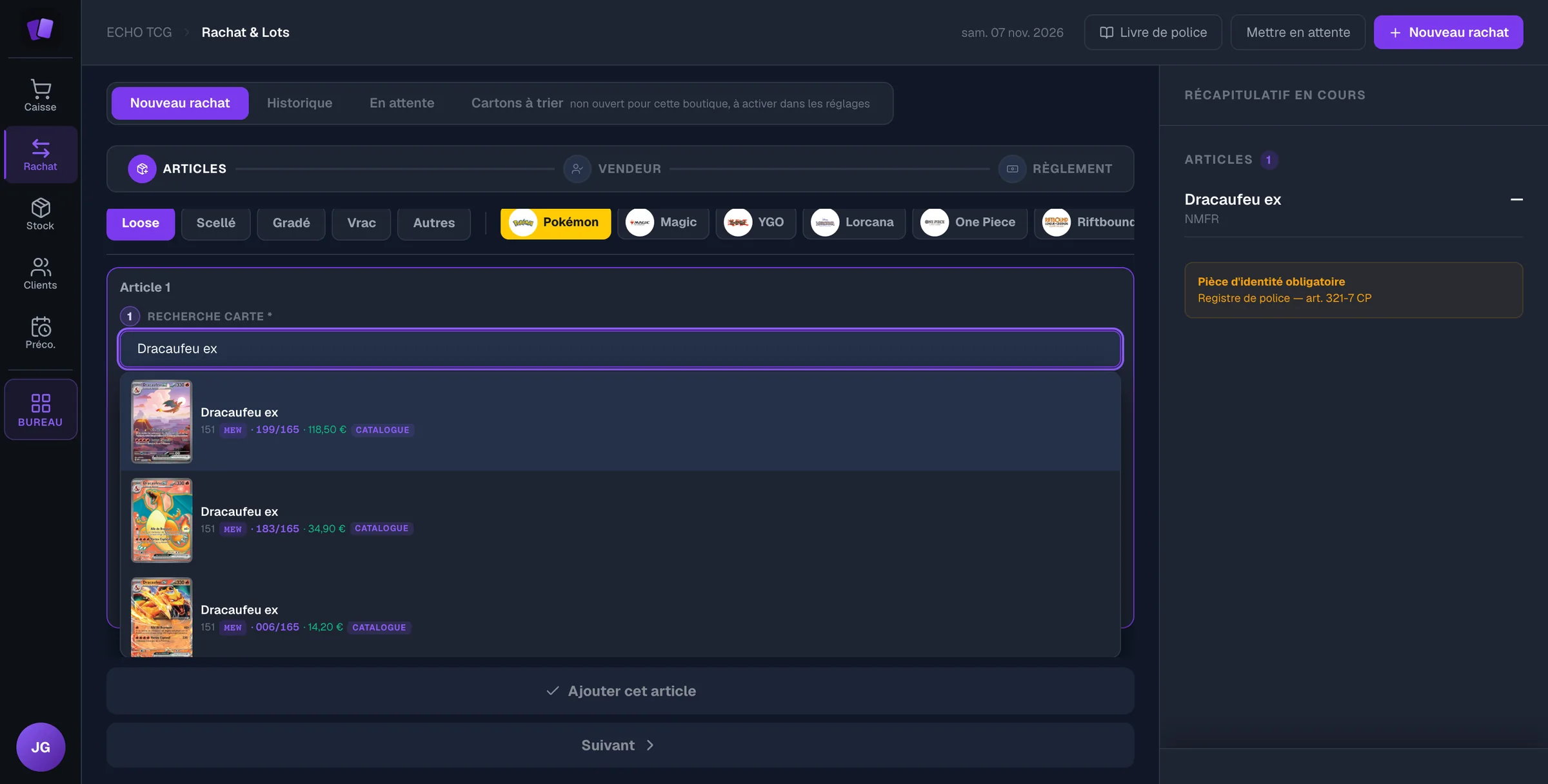
A buyback combines identification, commercial valuation and evidence of an acquisition. Separate the words describing an item from those determining an offer and from the records proving that a purchase was actually completed.
- Buyback: a shop’s purchase of goods offered by a seller, often a private individual in the card trade. An estimate or a preliminary discussion does not by itself mean that ownership has passed to the shop.
- Market valuation: an estimate of a reference’s market value using an identified source and defined criteria, called cote in French. It depends on matters such as version, language and condition, without guaranteeing the proceeds of a future sale.
- Condition: a description of a particular copy’s preservation, including its surfaces, edges and corners. An assessment should use explicit criteria and observable defects rather than relying only on a general impression or the appearance of the packaging.
- Near Mint: a common description for a very well-preserved copy under the scale used by a seller or platform. It does not automatically mean completely free of flaws and should not replace examining the physical card.
- Bulk: cards grouped without assigning a detailed individual value to every copy in the offer concerned. Contents, sorting and the counting unit need to be stated so that the buyer understands what the group actually includes.
- Lot: a group of goods offered or acquired in one commercial transaction. It may contain different references and conditions, and its total purchase price does not directly describe the cost allocated to each individual copy.
- Buyback price: the amount offered and, if the transaction proceeds, agreed for the shop’s acquisition of an item. It is distinct from an expected resale price and needs to remain connected to the goods actually purchased.
- Valuation adjustment: a reduction from an identified reference value to account for specified factors, such as condition or resale prospects, often called décote in French. State both the starting basis and the reason for the reduction.
- Provenance: information explaining where an item came from and how the shop acquired it. It is not limited to the card’s visual condition and should be supported by the documents available for the acquisition.
- Police register: the usual English rendering of livre de police, the French register of movable goods required for relevant second-hand trading activities. It records acquisitions and required information about goods and sellers, with controlled access.
When preparing a shop procedure, read the guide to buyback pricing alongside the guide to the police register. A commercial offer and a traceability requirement answer different questions, even when they arise during the same conversation with a seller.
What do till and tax terms mean?
These concepts distinguish sales documents, payment records and tax treatments. They describe different functions: a till summary does not replace every document needed for the shop’s accounting, and a file name alone does not establish what it contains.
- Till receipt: a document summarising a recorded sale, its items and payment using the information provided for that purpose. It does not automatically serve as an invoice where an invoice is required for the transaction concerned.
- Invoice: a document describing a commercial transaction and carrying the information required for its circumstances. It allows buyer and seller to connect the billed goods or services with an identifiable document reference and supporting records.
- Z report: the common name for a summary produced when a till period is closed, called ticket Z in French. It provides totals for that period without replacing the underlying transaction details or associated archives.
- Closing: the operation that ends a till period and retains its totals through the software’s recording mechanisms. Any subsequent corrections should remain understandable in relation to the operations already recorded and their supporting documents.
- Inalterability: a property intended to preserve recorded data without allowing silent rewriting. A correction should leave a trace of both the change and the original operation so that the history remains readable and available for examination.
- Standard VAT: the expression used here for a scheme where VAT applies to the taxable selling price rather than only the margin. The treatment depends on the transaction and the seller’s own tax position.
- Margin VAT: a special scheme whose calculation basis is the margin for eligible transactions involving second-hand goods. Its application depends in particular on the acquisition conditions, rather than simply on whether the item is a single card.
- NF525: the reference of a certification scheme for payment management software. Mentioning it in documentation does not establish the status of a particular product; the supporting evidence and the software version it covers need examination.
- FEC: abbreviation for fichier des écritures comptables, the French accounting entries file used to present computerised accounting records in a defined structure. A sales export is not necessarily that file and must be described accurately.
- Credit note: a document correcting or reducing an amount previously invoiced while preserving the link to the transaction concerned. In French retail conversation, avoir may also refer to spendable shop credit, so establish which meaning is intended.
The articles about margin VAT, the NF525 framework and the difference between an invoice and a receipt explore these subjects further. Check individual cases with the accounting firm, especially when acquisition evidence or the nature of a transaction is unclear.
Which terms help organise sales and events?
These words describe commitments, product availability and event preparation. Expected, reserved and physically present quantities represent different situations, which need to remain clear to everyone working in the shop rather than being combined under an ambiguous stock figure.
- Pre-order: an order recorded before a product can be handed to the customer, often before its official release. Its terms should explain what is promised, the payment arrangements and how delays or cancellation will be handled.
- Allocation: the quantity a supplier assigns to a shop for a product reference or release. It may differ from the amount requested, so sending an order request must not be treated as proof of a secured delivery.
- Reservation: setting aside an item or quantity for a customer under conditions defined by the shop. It does not necessarily mean that the sale has been paid for or that the customer has collected the goods.
- Acompte: a French term for a part-payment linked to an order and deducted from its price under the agreed terms. It is distinct from arrhes, so the payment’s classification and associated commitments should be made explicit.
- Replenishment: a further purchase intended to top up a reference or range already offered by the shop. The decision considers sales, available quantities and incoming orders without assuming that a one-off request represents lasting demand.
- Stocktake: counting the goods present and reconciling them with recorded quantities. Discrepancies should be explained and processed with a trace of the adjustment rather than concealed through an unexplained change to the stock figure.
- Stock turnover: a concept describing how inventory is renewed over a period. Comparing observations requires a consistent method, unit and product scope, because figures produced from different bases do not necessarily describe the same behaviour.
- Tournament: an organised event in which participants play matches under announced rules. Its administration may include registration, scheduling, results and rewards, with additional requirements specific to the game and the chosen playing format.
- Prize pool: the rewards planned for an event or its participants, often called dotation in French shop organisation. When supplied from shop merchandise, their withdrawal should be distinguished from a sale so that stock movements remain understandable.
- Loyalty programme: a commercial arrangement granting benefits under rules announced to customers. Its operation should distinguish earning, redemption and corrections, without automatically treating enrolment as permission to receive every form of commercial communication.
To move from vocabulary to working procedures, consult the pre-order and release guide. Shared definitions help staff know whether to wait for a delivery, set a product aside or record its collection, without assuming that expected stock is already available. Record the same distinctions in supplier notes and customer communications.
Frequently asked questions
- What is the difference between a booster and a display?
- A booster is a pack of cards; a display is a box containing several packs. Contents depend on the product reference, without a universal quantity implied by the name alone.
- Is a graded card necessarily in perfect condition?
- No. It has received an assessment under an organisation’s grading scale. Read the grade, organisation and copy-specific information instead of inferring condition from the holder alone.
- Does a sealed product always fall under standard VAT?
- Intact packaging does not determine the tax scheme. Provenance, acquisition conditions and tax circumstances need to be assessed using the necessary supporting records.
- Is a supplier allocation the same as a customer pre-order?
- No. An allocation is the quantity assigned by the supplier to the shop; a pre-order is an order recorded for a customer. They need to be reconciled without being confused.
Echo TCG: the POS and management software for card shops.
From €49 a month, with no commission on your sales. See pricing